
CozyWorld game guide · By CozyWorld
This guide covers our own game, written from the current game rules and browser checks.
American Mahjong Rules: Charleston and Jokers
American mahjong is the version played with a card of hands, eight jokers and a round of tile passing called the Charleston. This guide explains the set, how to read a card, each pass of the Charleston, what a joker may and may not do, when you can call a discard, how concealed hands work, how a win is paid, and how to practice all of it free on a table with its own practice card.
American mahjong, often spelled mah jongg, grew out of the Chinese game that reached the United States in the 1920s. It keeps the heart of mahjong, four players drawing and discarding tiles to complete a hand, and adds three things of its own: a printed card that lists every hand you are allowed to win with, eight joker tiles, and the Charleston, an exchange of unwanted tiles before play begins.
This guide walks through the rules in the order you meet them at the table. It also explains how Wisteria Court Mahjong, CozyWorld’s free table, lets you practice American style. One thing to know up front: the card used by most American players is published by the National Mah Jongg League, changes every year and has to be bought. Our table does not copy it. It uses a practice card of its own, with original hands that are read and played the same way.
The set: 152 tiles
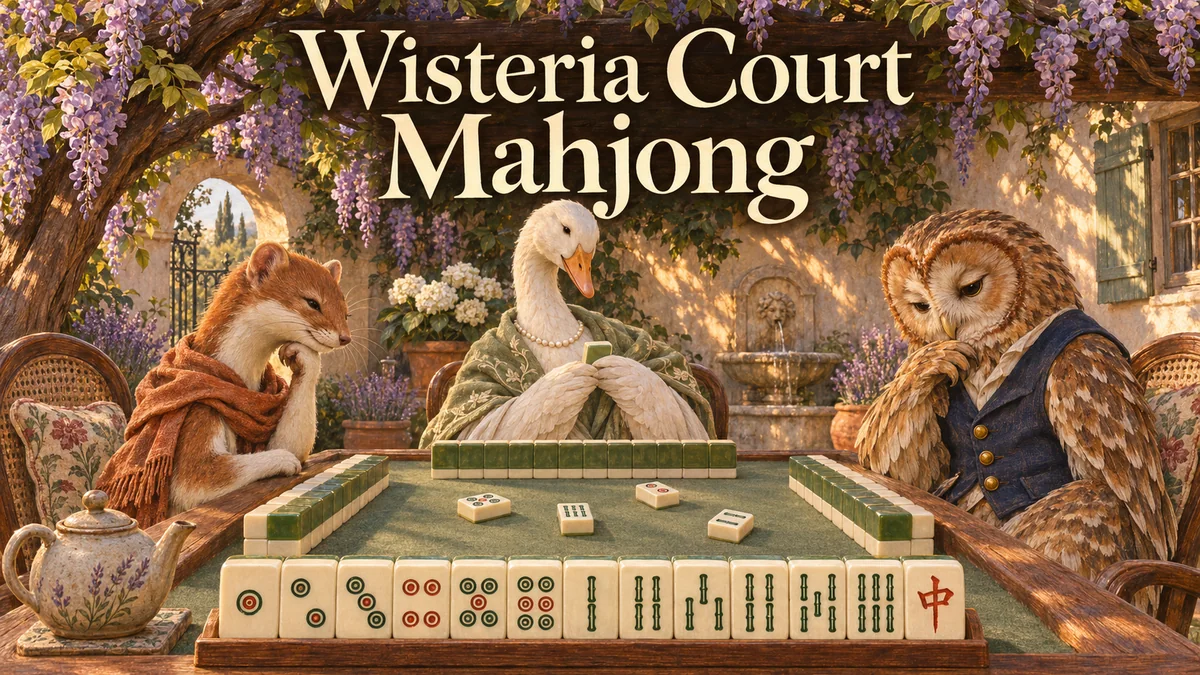
An American set has 152 tiles. There are three suits numbered one to nine, called Dots, Bams and Craks, with four copies of each tile. There are four each of the East, South, West and North winds and of the three dragons. There are eight Flowers and eight Jokers.
Two details differ from the Chinese game. All eight Flowers count as the same tile, and they are used inside hands instead of being set aside as bonuses. Each dragon also belongs with a suit: the green dragon with Bams, the red dragon with Craks and the white dragon, called Soap, with Dots. When a hand on a card asks for a suit and its dragon, that is the pairing it means.
The card
In American mahjong you cannot win with any four sets and a pair. You win by completing exactly one of the hands printed on the card, 14 tiles in the groups shown.
A card writes a hand as a row of groups, such as FF 2222 4444 6666. Numbers are suit tiles, F is a Flower, N, E, W and S are winds, and D is a dragon. Colors stand for suits: groups printed in one color must all be in one suit, and groups in different colors must be in different suits, though you choose which suit is which.
Groups have names by size: a pair is two identical tiles, a pung three, a kong four, a quint five and a sextet six. Since there are only four copies of any tile, a quint or sextet always needs jokers.
Each hand has a value, and each is marked as either exposed or concealed. A concealed hand must be built without calling any discard except the one that completes it.
The National Mah Jongg League, founded in New York City in 1937, issues a new official card each year, and other organizations publish cards of their own. Learning to read one card teaches you to read them all.
The deal
The tiles are shuffled and built into walls, and each player takes 13 tiles, with East, the dealer, taking 14. Players usually stand their tiles on a rack so that nobody else can see them.
Before anyone discards, everyone looks at their tiles, picks the one or two hands on the card they seem closest to, and gets ready to pass the rest away.
The Charleston
The Charleston is a set of passes in which every player gives three unwanted tiles to another player and receives three in return.
The first Charleston is compulsory and has three passes: three tiles to the player on your right, three to the player across, and three to the player on your left.
The second Charleston happens only if every player agrees to it. It runs the other way: left, across, then right. If any one player wants to stop, it is skipped.
On the last pass of each Charleston you may pass blind. If you would rather not give up three of your own tiles, you may take one, two or all three of the tiles being passed to you and send them on without looking at them.
Last comes the courtesy pass. You and the player across each say how many tiles you would like to swap, from none to three, and you exchange the lower of the two numbers.
Jokers may not be passed at any point in the Charleston.
| Pass | Direction | Tiles | Notes |
|---|---|---|---|
| First Charleston, 1 | Right | 3 | Compulsory |
| First Charleston, 2 | Across | 3 | Compulsory |
| First Charleston, 3 | Left | 3 | Compulsory; you may pass blind |
| Second Charleston, 1 | Left | 3 | Only if all four players agree |
| Second Charleston, 2 | Across | 3 | |
| Second Charleston, 3 | Right | 3 | You may pass blind |
| Courtesy pass | Across | 0 to 3 | The lower of the two numbers asked for |
A turn, and calling a discard
East begins by discarding one tile. From then on each player in turn draws a tile from the wall and discards one, naming it aloud. Play passes to the right.
You may call the most recent discard, out of turn, to complete a pung, kong, quint or sextet that your hand needs. You then lay that group face up, jokers included, and discard. Play continues from you.
You may not call a discard for a single tile or a pair, with one exception: you may call any tile if it is the last one you need for mahjong.
There are no chows in American mahjong, so runs of three are never called.
If two players want the same tile, a player calling it for mahjong comes first. Otherwise it goes to the player whose turn would come sooner.
A discarded joker is dead. Nobody may call it.
Jokers
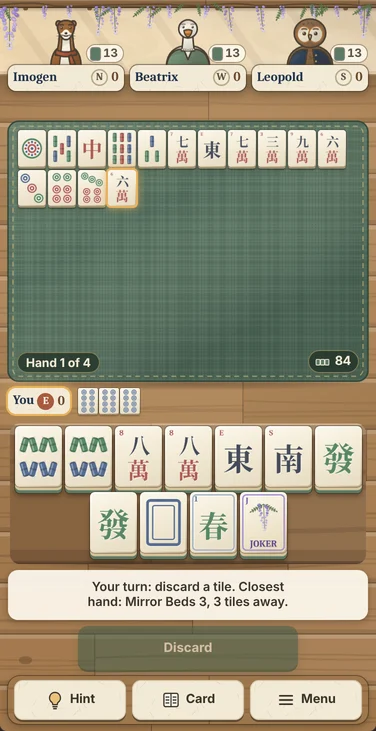
A joker can stand in for any tile, but only in a group of three or more identical tiles: a pung, kong, quint or sextet. A joker can never be part of a pair, and it can never be a single tile, which rules it out of groups made of singles such as a run of N E W S or the digits of a year.
Jokers on the table can be won back. When it is your turn and you hold the real tile that a joker in an exposed group is standing in for, you may swap your tile for the joker. The group can be anyone’s, including your own, and the joker goes into your hand to use again.
Because of that rule, exposing a group with jokers in it gives the other players a chance to take them. It is one reason to stay concealed for as long as you can.
Winning and payment
You win by completing a hand on the card and declaring mahjong, either on a tile you draw or on a discard.
The winner is paid the value printed beside the hand. As American rules are usually played, the player who discarded the winning tile pays double and the other two pay the single value; if the winner drew the tile from the wall, all three pay double. A hand completed without a single joker earns a bonus, which is usually double again.
If the wall runs out before anyone wins, the hand is a draw, known as a wall game, and nobody is paid.
A player whose hand can no longer be completed, for example because the tiles they have exposed fit no hand on the card, can be called dead and stops drawing for the rest of that hand. Wisteria Court Mahjong leaves this rule out: it lets you play on and learn from the mistake.
American mahjong strategy for beginners
Choose a section of the card, not a single hand, during the Charleston. Keep the tiles that fit two or three neighboring hands and pass the rest.
Pass winds and stray dragons early unless your tiles point at a winds or dragons hand. They fit few hands.
Count pairs before you commit. A pair cannot use a joker and cannot be called, so a hand with several pairs is much harder than its value suggests.
Hold jokers until the end. A joker is never a bad tile to keep, and it should almost never be discarded.
Watch the exposures. Two laid-down groups usually narrow a player to one or two hands on the card, which tells you which tiles are dangerous to throw.
Be slow to make the first call. It fixes your direction and shows it to the table.
Practice American style free
Wisteria Court Mahjong plays American style against three computer hosts in the browser, free and without an account. It runs the full Charleston with blind passes, the vote on the second Charleston and the courtesy pass, then the hand itself with calls, joker swaps and concealed hands.
Its card is the Wisteria Court Practice Card: 24 original hands in nine families, from runs in one suit to winds and dragons, quints and concealed pairs. It is our own card, written for this table, so its hands are not the ones on the League’s card or any other published card. What carries over is the skill: reading colors and groups, choosing a hand, and knowing when a joker or a call is allowed.
The Card button shows the three hands your tiles are nearest to, tile by tile, with the ones you still need shown faint. Lessons six to eight cover reading the card, the Charleston, and jokers and calling.
Sources
National Mah Jongg League, “The League” and “The Game”, https://www.nationalmahjonggleague.org/league.aspx and https://www.nationalmahjonggleague.org/game.aspx, read on November 9, 2026: the founding in New York City in 1937, the new card of standard hands and rules each year, the Charleston as the passing of three unwanted tiles, and jokers completing quints and sextets.
Tom Sloper, Sloperama, “Frequently Asked Questions about National Mah Jongg League rules” (FAQ 19), https://www.sloperama.com/mjfaq/mjfaq19.html, read on November 9, 2026: jokers only in pungs, kongs, quints and sextets and never in a pair or single; a discard taken only for a pung, kong, quint or sextet or for mahjong; the group sizes on the card; the order and blind passes of the Charleston; redeeming a joker on your turn; and the doubled payments.
I Love Mahj, “Beginner’s Guide to American Mah Jongg”, https://ilovemahj.com/american-mahjong-getting-started, read on November 9, 2026: 152 tiles with eight Jokers and eight Flowers, 14 tiles for East and 13 for the others, the passes of both Charlestons, the courtesy pass, jokers not passed, who takes a contested discard, concealed hands, the wall game and dead hands.
Tom Sloper, Sloperama, “Which mah-jongg do you play?” (FAQ 2b), https://www.sloperama.com/mjfaq/mjfaq02b.html, read on November 9, 2026: the American set as a Chinese set with eight jokers added, Flowers used in the hand, and a card that changes every year.
Wisteria Court Mahjong: the practice card and the rules of our own table come from the game’s card and rules modules, which the game and its tests share.
Keep playing
American mahjong rewards one decision above all: choosing a hand early and letting go of everything else. Use the Charleston to commit, keep your jokers for the big groups, and stay concealed until a call clearly helps. The practice card in Wisteria Court Mahjong shows the three hands your tiles are closest to, so you can learn to read a card before you sit down with your own group and the card they play.
- Play Wisteria Court Mahjong: features, controls and FAQ
- How to play mahjong: rules for beginners
- Mahjong tiles: every tile, its name and how to read it
- Mahjong hands and scoring: the Hong Kong faan chart
- Hong Kong, American and riichi mahjong compared
- Teahouse Mahjong: the tile-matching solitaire puzzle
- Chickadee Hill Cribbage: two-player cribbage
More guides and roundups
Grown-up games that open in a browser tab: classic cards and board games, sudoku, a village whodunit and a village to share, plus the best free game sites run by newspapers and nonprofits.
Best Cozy Card Games to Play Online for FreeSolitaire, trick-taking and card games for two, all free in your browser with friendly animal opponents. Then pick a cozy card game for a longer stay.
Tile Matching Games: Four Kinds to Play FreeTile matching games come in four kinds, and they play very differently: triple tile match, mahjong solitaire, match 3 and memory pairs. CozyWorld has a free browser game for each, plus two domino and mahjong games for people who searched for tile games more widely.
How to Play Spades: Rules, Bidding and ScoringSpades is the classic partnership card game where you say how many tricks you will take and then try to take exactly that many. Here is how to deal, how to bid and count a hand, how nil works, when spades may be led, how a hand is scored, why bags matter, how a game ends, how strong each level of our computer players is, and the partnership tips, strategy and common mistakes that make or break a contract.