
CozyWorld game guide · By CozyWorld
This guide covers our own game, written from the current game rules and browser checks.
How to Play Mahjong: Rules for Beginners
Mahjong is a four-player game of drawing and discarding tiles until one player completes a hand. This beginner guide covers the real game, not the matching puzzle: the tiles, the deal, what happens on a turn, how to claim a discard for a chow, pung or kong, what a winning hand looks like, how a hand is scored and paid, and the habits that win more hands. It follows Hong Kong style, the plainest place to start, and points out where American mahjong differs.
Mahjong is a game for four players, played with 144 tiles instead of cards. Everyone holds 13 tiles. On your turn you draw one and discard one, and you may also take another player’s discard when it completes a set. The first player to complete a full hand, four sets and a pair, calls mahjong and is paid by the others. If you have played rummy, you already know the shape of it.
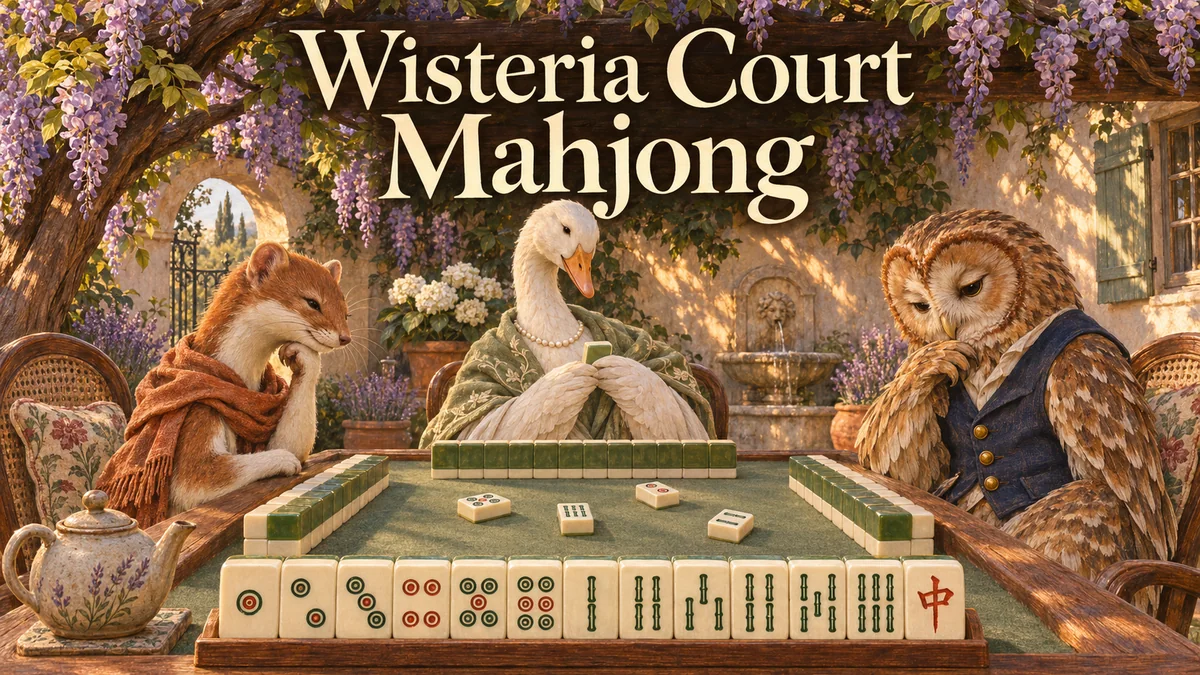
One thing to clear up first: the tile-matching puzzle that many websites call mahjong is mahjong solitaire, a one-player game that borrows the tiles. This guide is about the real four-player game. It follows Hong Kong style, which has the fewest extras and is the usual place to start, and it notes where American mahjong goes its own way. Every step can be tried in Wisteria Court Mahjong, CozyWorld’s free table, where three computer hosts play the other seats and a coach line explains each choice as it comes up.
What you need
Four players and a mahjong set. A standard Chinese set has 144 tiles: three suits numbered one to nine (dots, bamboo and characters), four winds, three dragons, and eight bonus tiles called flowers and seasons. There are four copies of every suit, wind and dragon tile, and one of each flower and season. Our tile guide shows how to read each of them.
An American set has 152 tiles, because it adds eight jokers. Riichi, the Japanese game, uses 136, leaving the flowers out.
A real table also uses dice and sometimes racks to hold the tiles. Online, the table deals for you.
The aim: four sets and a pair
A winning hand has 14 tiles: four sets of three and one pair. There are three kinds of set.
A chow is three tiles in a row in the same suit, such as the 4, 5 and 6 of bamboo. A pung is three identical tiles, such as three 8 of dots or three East winds. A kong is four identical tiles; it counts as one set, and because it uses an extra tile you draw a replacement when you declare it.
Winds and dragons cannot make a chow, since they have no numbers. They can only be collected as pungs, kongs or the pair.
A few special hands break the pattern. The best known is Thirteen Orphans: one of each one, nine, wind and dragon, with any one of them doubled.
| Set | What it is | Example | May be claimed from |
|---|---|---|---|
| Chow | Three in a row, one suit | 4, 5, 6 of bamboo | Only the player just before you |
| Pung | Three identical tiles | Three red dragons | Any player |
| Kong | Four identical tiles | Four 2 of dots | Any player |
The deal and the winds
The tiles are shuffled face down and built into a wall. Each player takes 13 tiles, and the dealer takes 14.
Every seat has a wind. The dealer is East, and the other seats are South, West and North in the order of play. Play runs counterclockwise, which means the turn passes to the player on your right. The wind tiles matter for scoring: a pung of your own seat wind is worth extra.
In Chinese styles, a flower or season is never kept in the hand. When you draw one you set it face up beside your tiles and draw a replacement.
A turn: draw one, discard one
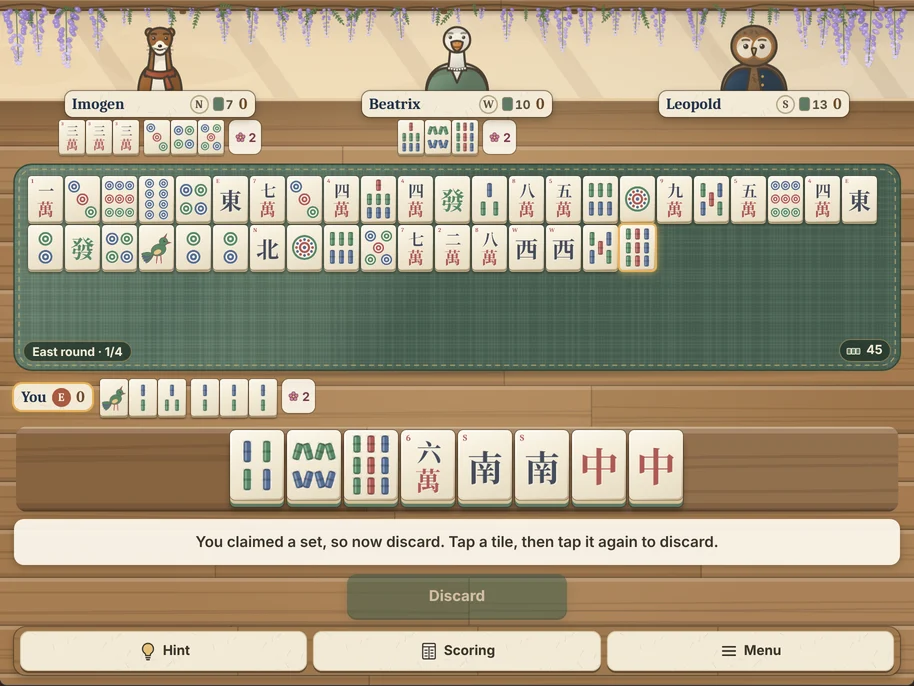
The dealer starts by discarding one of their 14 tiles. After that, every turn is the same: draw a tile from the wall, then discard one face up in the middle. You always finish your turn with 13 tiles in your hand, not counting kongs.
Most of the skill is in the discard. You keep tiles that are close to forming sets, such as a pair, or two numbers in a row, and throw the ones that connect to nothing.
If you draw the tile that completes your hand, you declare mahjong on the spot. That is a self-drawn win, and it pays better than winning on a discard.
Claiming a discard
When someone discards a tile you need, you may be able to take it instead of waiting for your turn. Only the most recent discard can be claimed, and only to complete a set at once.
Anyone may claim a discard to complete a pung or a kong. Only the next player in turn may claim it for a chow. Anyone may claim it to complete their whole hand and win. If two players want the same tile, a win beats a pung or kong, and a pung or kong beats a chow.
A claimed set is laid face up on the table for everyone to see. You then discard, and play carries on from you, so the players between the discarder and you lose their turn.
Claiming is a trade. It builds your hand faster, and it shows the table what you are collecting. In Hong Kong scoring it also gives up the bonus for a concealed hand.
Kongs and flowers
You can make a kong three ways: claim a discard when you hold three of that tile, declare four of a kind from your own hand on your turn, or add the fourth tile to a pung you claimed earlier. Each time, you draw a replacement tile so that your hand still has enough tiles to finish.
Adding to a pung carries one risk. If another player needs that very tile to complete their hand, they may take it and win. This is called robbing the kong.
Flowers and seasons work the same way as far as the replacement goes. They add to your score in Hong Kong style, more so when the number on the tile matches your seat.
Winning, scoring and paying
A hand ends when someone completes four sets and a pair and declares mahjong, or when the wall runs out, which is a draw.
In Hong Kong style only the winner is paid. The hand is worth a number of faan, a doubling unit, for the patterns it contains: for example one faan for a hand of all chows, three for all pungs or for one suit plus honors, and seven for one suit alone. Faan are converted to points with a table. Many Hong Kong groups require at least three faan to win, and casual games often lower that to one or none.
Who pays depends on the table. A common Hong Kong rule has the discarder pay for everyone; another has the discarder pay double and the others pay single. A self-drawn win is paid by all three players. Wisteria Court Mahjong uses the second rule and lets you choose the minimum: any hand, one faan or three. Our guide to mahjong hands and scoring has the full chart.
How American mahjong differs
American mahjong keeps the draw, the discard and the pung and kong, and changes the rest. There are no chows. A winning hand must match one of the hands printed on a card, which the National Mah Jongg League changes every year. Eight jokers can stand in for tiles in groups of three or more. Before play begins, the players swap unwanted tiles in a ritual called the Charleston.
It is its own game, and worth learning after the basics here. Our guide to American mahjong rules covers it in full.
Beginner strategy
Throw lone winds and dragons first, unless you already hold a pair of them. A single honor tile can only ever become a pung, so it is the hardest tile to use.
Keep tiles from the middle of a suit over ones and nines. A 5 can join a chow with the 3 and 4, the 4 and 6, or the 6 and 7; a 1 can only join the 2 and 3.
Prefer two-sided waits. Holding a 4 and 5 lets you finish the chow with a 3 or a 6, eight tiles in all. Holding a 4 and 6 only works with the 5, four tiles.
Count what is gone. If three copies of a tile are already face up on the table, the fourth can never become your pung, and your pair of them is now only a pair.
Do not claim everything. Each claim shows your hand and ends your chance of a concealed hand. Claim when it brings you clearly closer to winning.
Late in a hand, when another player has three sets showing, throw tiles that have already been discarded safely rather than fresh ones.
Common beginner mistakes
Forgetting the pair. Four sets are not a hand without it, and a hand that needs the pair last has the fewest tiles that can finish it.
Trying to chow from the wrong player. A chow may only be claimed from the player whose turn comes just before yours.
Breaking a finished set to chase a prettier hand. A complete chow or pung is worth keeping unless you are deliberately collecting one suit.
Winning below the minimum. At a table with a three faan minimum, a plain hand cannot be declared, so check what your hand is worth before you call for tiles.
Learn it at Wisteria Court
Wisteria Court Mahjong is free in the browser on a phone, tablet or computer, with no account. You play against three hosts, Leopold the owl, Beatrix the goose and Imogen the stoat, at Gentle, Steady or Sharp strength.
Eight short lessons use real tiles and questions you answer by tapping. A coach line under your tiles says what each choice means (on a phone turned sideways, when a claim offers more choices than fit in one row, the choice buttons take the coach line’s place until you choose), and the Hint button suggests a move with the reason. Games run 4, 8 or 16 hands, and the game is saved on your device as you play.
The table plays Hong Kong style and American style. A few things are simplified so that a game has a set length: the deal passes on after every hand, the wall is played to its last tile, and scores are kept as plain points.
Sources
Tom Sloper, Sloperama, “Which mah-jongg do you play?” (FAQ 2b), https://www.sloperama.com/mjfaq/mjfaq02b.html, read on November 9, 2026: the tile counts of each style, hands of 13 tiles won on the 14th, and Hong Kong style paying only the winner.
Hong Kong Mahjong, “Hong Kong Mahjong Scoring Chart”, https://www.mahjonggame.hk/learn/hk-mahjong/scoring, read on November 9, 2026: the faan values quoted, the three faan minimum with casual games at one, and the discarder paying under the common rule.
Mahjong Scoring, “Points Tables”, https://mahjongscoring.org/info/scoring, read on November 9, 2026: the two ways of paying a discard win and the doubled payment for a self-drawn win.
PlayFaceToFace, “Mahjong Tiles”, https://www.playfacetoface.com/mahjong-tiles, read on November 9, 2026: the breakdown of the 144 tiles and the bonus tiles being set aside and replaced.
I Love Mahj, “Beginner’s Guide to American Mah Jongg”, https://ilovemahj.com/american-mahjong-getting-started, read on November 9, 2026: the 152 tile American set, the Charleston and the joker rules summarized here.
Wisteria Court Mahjong: the rules of our own table come from the game’s rules module, which the game and its tests share.
Keep playing
Mahjong looks like a lot at first because of the tiles, and it settles quickly: draw, discard, collect sets, watch what the others throw. Take the first four lessons in Wisteria Court Mahjong, play a few hands at Gentle with the coach on, and ask for a hint whenever a choice is unclear. When four sets and a pair feel natural, add a minimum of one faan, then three, and try American style with its Charleston and jokers. If it is the calm matching puzzle you were after, that is Teahouse Mahjong.
- Play Wisteria Court Mahjong: features, controls and FAQ
- Mahjong tiles: every tile, its name and how to read it
- Mahjong hands and scoring: the Hong Kong faan chart
- American mahjong rules: the Charleston, jokers and the card
- Hong Kong, American and riichi mahjong compared
- Teahouse Mahjong: the tile-matching solitaire puzzle
- How to play mahjong solitaire
- Larch Hollow Spades: partnership spades in a potting shed
- Sugar Camp Euchre: partnership euchre in a sugar shack
More guides and roundups
Grown-up games that open in a browser tab: classic cards and board games, sudoku, a village whodunit and a village to share, plus the best free game sites run by newspapers and nonprofits.
Best Cozy Card Games to Play Online for FreeSolitaire, trick-taking and card games for two, all free in your browser with friendly animal opponents. Then pick a cozy card game for a longer stay.
How to Play Spades: Rules, Bidding and ScoringSpades is the classic partnership card game where you say how many tricks you will take and then try to take exactly that many. Here is how to deal, how to bid and count a hand, how nil works, when spades may be led, how a hand is scored, why bags matter, how a game ends, how strong each level of our computer players is, and the partnership tips, strategy and common mistakes that make or break a contract.
Tile Matching Games: Four Kinds to Play FreeTile matching games come in four kinds, and they play very differently: triple tile match, mahjong solitaire, match 3 and memory pairs. CozyWorld has a free browser game for each, plus two domino and mahjong games for people who searched for tile games more widely.