
CozyWorld game guide · By CozyWorld
This guide covers our own game, written from the current game rules and browser checks.
How to Play Minesweeper: Rules and Patterns
Minesweeper is the classic logic puzzle of numbered squares and hidden mines. Here are the rules and the three standard sizes, what the numbers mean, flags and chording, the patterns that solve most boards, what to do when a guess is forced, common mistakes and tips.
Minesweeper is a one-player logic puzzle played on a grid of covered squares. Some squares hide mines. Open a safe square and it shows a number: how many mines touch it. Use the numbers to work out where every mine is, open every square that is safe, and you win. Open a mine and the game is over.
This guide covers the standard rules and board sizes, what the numbers mean, flags and chording, and the handful of patterns that solve most of a board: 1-1, 1-2, 1-2-1 and 1-2-2-1. Then it explains when a guess is really forced and how to guess well, with figures from our own simulation, followed by common mistakes and tips. The examples use Linden Meadow Minesweeper, CozyWorld’s free minesweeper game, where the mines are bumblebee nests in a hay meadow and the squares are patches of turf.
Minesweeper rules and the goal
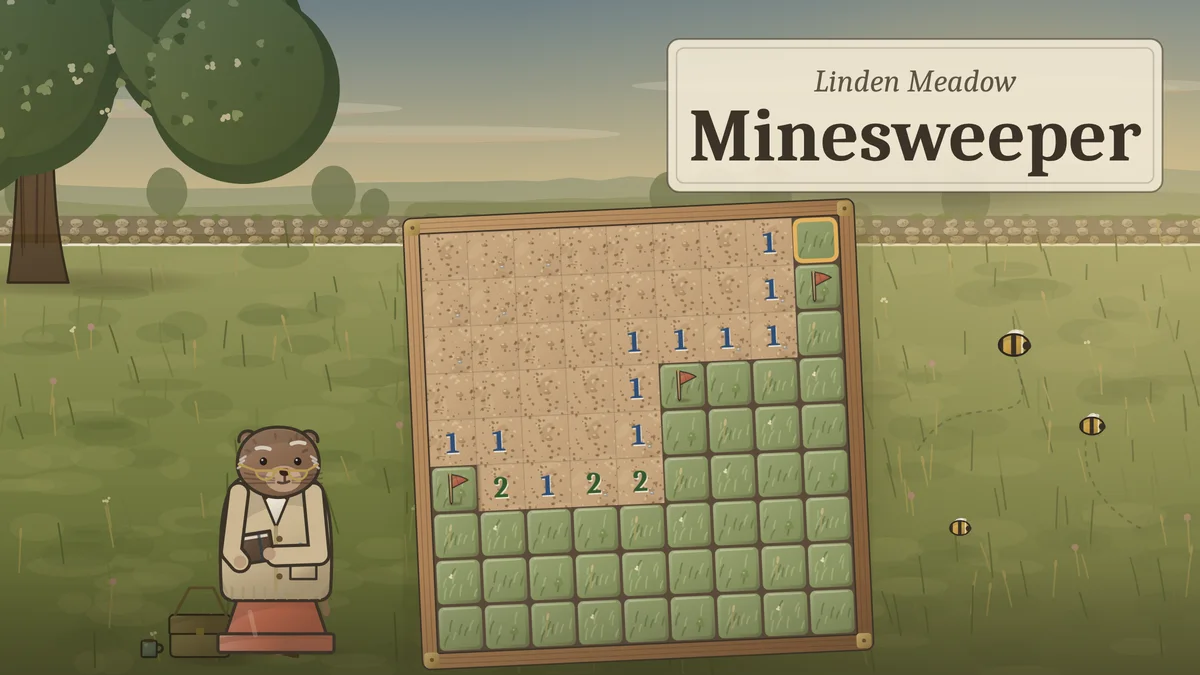
The board is a rectangle of covered squares, and a fixed number of them hide mines. You know how many mines there are, but not where. On each turn you open one covered square. If it holds a mine, you lose. If it is safe, it shows a number from 1 to 8: how many of the eight squares touching it, diagonals included, hold mines.
A safe square with no mines around it shows no number, and the game opens all eight of its neighbors for you, then the neighbors of any of those that are also blank, and so on. That is why one click can open a large stretch of the board.
You can mark a square you are sure holds a mine with a flag. Flags are only notes for yourself: the game does not need them, and a flag does nothing except stop you opening that square by accident. A counter shows the number of mines minus the number of flags you have placed.
You win when every safe square is open. You do not have to flag the mines to win; most versions flag the rest for you when you open the last safe square.
Minesweeper board sizes
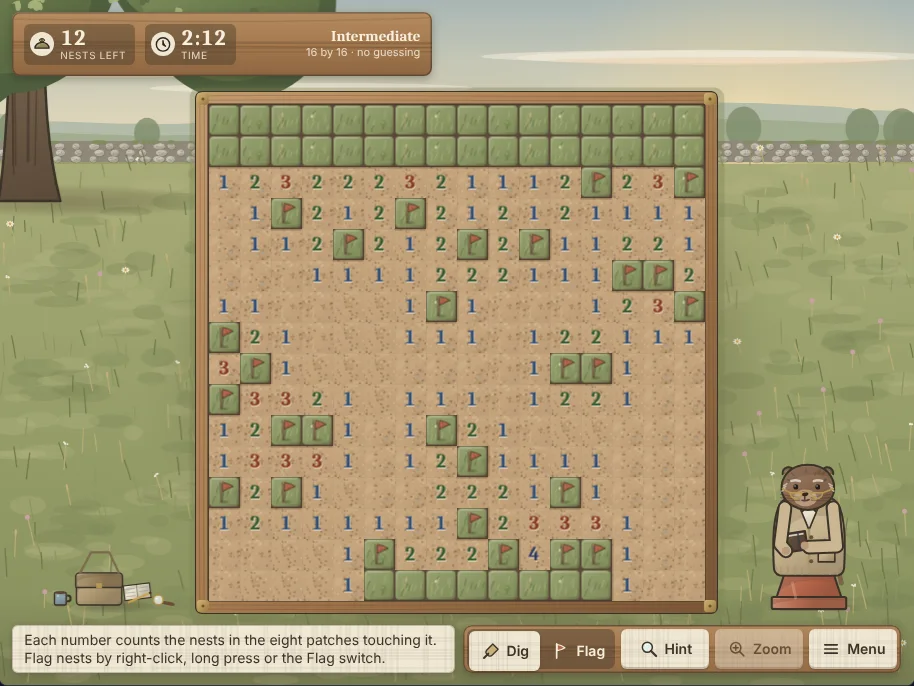
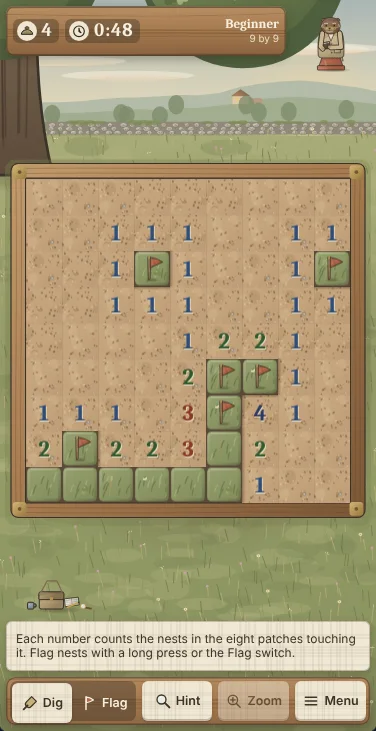
Three sizes have been standard for decades, and most versions also let you set a custom size and mine count. Beginner is 9 by 9 with 10 mines, Intermediate is 16 by 16 with 40, and Expert is 30 by 16 with 99. Beginner has a mine on about one square in eight, Intermediate on about one in six and Expert on about one in five, and that extra density makes Expert much harder than its size alone suggests.
Linden Meadow Minesweeper has all three, plus custom boards from 5 by 5 to 30 by 30. On a phone held upright, Expert turns to 16 across by 30 down so it fits the screen better, and you can pan it with one finger and pinch to zoom.
| Level | Board | Mines | Share of squares with a mine |
|---|---|---|---|
| Beginner | 9 by 9 (81 squares) | 10 | 12.3 percent |
| Intermediate | 16 by 16 (256 squares) | 40 | 15.6 percent |
| Expert | 30 by 16 (480 squares) | 99 | 20.6 percent |
The first click
The first square you open is never a mine: the mines are placed after your first click, away from it. Many versions also keep the eight squares around it clear, so the first click always opens an area to work from rather than a single number. Linden Meadow Minesweeper does both, so your first dig always opens a stretch of meadow.
Where to make that first click is a matter of taste. A click in the middle opens a stretch with room to grow in every direction. A click near an edge or a corner is more likely to open a large area on boards where only the first square is kept clear, because an edge square has fewer neighbors that could hold a mine.
Controls in Linden Meadow Minesweeper
With a mouse, click a patch to dig it and right-click to place or lift a flag. When the board is larger than the meadow, drag to move it, and use Ctrl with the scroll wheel, or a trackpad pinch, to zoom.
On a phone or tablet, tap to dig and press and hold to flag: a ring fills around the patch, then the flag goes down. The Dig and Flag switch on the shelf swaps the two, so a plain tap flags, which many players find calmer on a small screen. Drag with one finger to move a large board, pinch to zoom, and use Fit to see the whole board.
With a keyboard, the arrow keys move a visible cursor, Space or Enter digs, F flags, T switches Dig and Flag, and H shows a hint. The hint points at a patch that can be proven safe and says which numbers prove it.
The meadow’s mines are bumblebee nests, which Ambrose, a field vole, maps so the mower can go round them before the hay is cut. It is a fitting job for a vole: bumblebees often nest in abandoned rodent dens underground or under tufts of grass.
Chording: opening around a finished number
Chording is the fastest move in minesweeper. When a number already has as many flags around it as its value, every other covered square around it must be safe. Click the number itself and the game opens all of them at once. In Linden Meadow Minesweeper you click or tap the number (or middle-click it); pressing a number shows which patches it would open.
Chording trusts your flags completely. If one of the flags around the number is wrong, the chord opens the real mine and the game is over. Chord only around flags you placed by proof, not by hunch.
Many fast players flag only the mines they need for chording and never bother with the rest. That is a fine habit once the patterns below are second nature.
Beginner strategy: read one number at a time
Most of a board is solved by looking at one number and the covered squares around it. If a number has exactly as many covered squares around it as its value, all of those squares are mines: a 1 with a single covered neighbor has its mine right there. If a number already touches as many known mines as its value, all of its other covered neighbors are safe.
Once you know a mine, subtract it from every number that touches it. A 3 with one known mine beside it behaves like a 2 for the squares that are left, and a 1 next to a known mine is finished. Reading the reduced numbers is what makes the patterns below visible on a messy board.
Work along the edges of the open area rather than staring at the middle of it, and finish one corner before moving to the next.
The 1-1 and 1-2 patterns
Two small patterns sit underneath nearly every other one. Both are read along a straight edge, where a row of numbers faces a row of covered squares.
The 1-1 pattern: starting from a wall or a corner of the board, the first 1 touches two covered squares and the second 1 touches those two plus a third. The first 1’s mine must be in the two squares they share, which also satisfies the second 1, so the third covered square, the one only the second 1 touches, is safe.
The 1-2 pattern: where a 1 sits next to a 2 along a straight edge, the 2 touches three covered squares and needs two mines in them. The 1 touches two of those three and can hold only one mine there, so the third square, the one the 1 does not touch, must be a mine. And because the 1’s mine is in the squares it shares with the 2, the covered square on the 1’s other side is safe. Minesweeper players often write this as 1-2-X: on a row, the X past the 2 is always a mine.
| Pattern | What you see | What follows |
|---|---|---|
| 1-1 from a wall | Two 1s side by side, the first one against the wall | The covered square past the second 1 is safe |
| 1-2 | A 1 beside a 2 | The covered square past the 2 is a mine, and the one past the 1 is safe |
The 1-2-1 and 1-2-2-1 patterns
The two most famous patterns are just the 1-2 pattern used from both ends.
The 1-2-1 pattern: a 1, a 2 and a 1 in a row along a straight edge. Reading 1-2 from the left puts a mine opposite the right-hand 1, and reading it from the right puts a mine opposite the left-hand 1. That is the 2’s two mines, so the square opposite the 2 is safe, and so are the squares just past each 1. In short: mines under the 1s, nothing under the 2.
The 1-2-2-1 pattern: a 1, two 2s and a 1 in a row along a straight edge. Reading 1-2 from each end puts a mine opposite each 2, and everything else along that edge, under the 1s and past them, is safe. In short: mines under the 2s.
Both patterns often hide inside larger numbers. Subtract the mines you already know, and a 2-3-2 beside a row of flags can turn out to be a 1-2-1.
| Pattern along an edge | Mines | Safe |
|---|---|---|
| 1-2-1 | Opposite each 1 | Opposite the 2, and just past each 1 |
| 1-2-2-1 | Opposite each 2 | Opposite each 1, and just past each 1 |
When a guess is forced
On a classic board, mines are placed at random, and sometimes no square can be proven safe from the numbers you can see. Then a guess is forced. Before you guess, make sure it really is: look again at every pair of numbers side by side, and near the end of the game count the mines left, because the counter often settles what the numbers cannot.
To see how often it happens, we ran our own simulation of 1,000 classic boards at each size, with the first click in the middle (it always opens an area, as it does in Linden Meadow). A solver that only ever opens squares it can prove safe cleared 92.0 percent of Beginner boards, 70.5 percent of Intermediate boards and 16.1 percent of Expert boards without a single guess. On every other board it reached a point where no square could be proven safe.
How you guess matters on the big boards. When our simulated player, at each forced guess, opened the square least likely to hold a mine, it won 97.0 percent of Beginner games, 85.9 percent of Intermediate and 52.1 percent of Expert. When it picked any unproven square at random instead, it won 96.3 percent, 84.2 percent and 39.4 percent. These are computer players that never make a mistake in their logic, so a person’s results will be lower, but the gap on Expert shows what careful guessing is worth.
| Size | Boards cleared with no guess | Wins, guessing the safest square | Wins, guessing at random |
|---|---|---|---|
| Beginner | 92.0 percent | 97.0 percent | 96.3 percent |
| Intermediate | 70.5 percent | 85.9 percent | 84.2 percent |
| Expert | 16.1 percent | 52.1 percent | 39.4 percent |
How to guess well
Pick the square least likely to hold a mine. A square that touches no number at all carries roughly the board’s overall share of the mines left, while a square next to a 1 that has three covered neighbors carries about one chance in three, so compare before you choose. The Hint in Linden Meadow Minesweeper does this work for you on a classic board: when nothing can be proven, it marks the patch least likely to hold a nest and gives its chance.
Prefer a guess that will tell you something. A square whose number would settle its neighbors is worth more than one in a sealed-off pocket that settles nothing even if it is safe.
Guess early rather than late. If a guess is unavoidable, it does not get safer after an hour of careful work elsewhere; it only costs you more if it goes wrong. True 50-50s, where two squares are exactly alike and nothing else on the board can ever tell them apart, are best taken quickly.
No guessing in Linden Meadow Minesweeper
Linden Meadow Minesweeper deals every board with no guessing unless you turn it off. Before a board is offered, the game’s own solver plays it from your first dig, seeing only what you would see: the dug patches, their numbers and the nests left. It proves patches safe with single numbers, pairs of numbers (the 1-1 and 1-2 patterns among them) and, when those run out, every arrangement of nests along the dug edge that fits the numbers and the counter. A board is kept only if the solver clears all of it that way, so there is always a patch you can prove safe.
Our tests replay thousands of these boards, at every standard size and at the largest and narrowest custom sizes, and check every step the solver takes against an independent search over all the arrangements a player could still believe. Turn no guessing off in Settings for classic dealing, guesses and all.
Today’s meadow is a 16 by 16 board with 40 nests and no guessing, dealt from the date, so everyone gets the same board on the same day, with the same first stretch already dug. Your first try each day counts toward a streak of days.
Common mistakes
Flagging on a hunch. A wrong flag is worse than no flag, because chording trusts it. Flag only what you can prove, and lift a flag the moment a number disagrees with it.
Guessing when a deduction is available. Most "forced" guesses on a no-guess board, and many on a classic one, are pairs of numbers you have not compared yet. When you feel stuck, look for a 1-2 along an edge.
Forgetting the counter. With a few mines left, the count can decide a corner the numbers cannot. If two mines remain and only one arrangement of the last few covered squares holds exactly two, that is the answer.
Reading a number without subtracting its known mines. A 2 next to a flagged mine is a 1 for everything else around it, and the patterns only appear once you read it that way.
Tips for faster, cleaner games
Chord instead of opening squares one by one. Every finished number is a chance to open several squares with one click.
Clear one region before moving on. Jumping around the board means re-reading the same numbers over and over.
Use the hint to learn, not to finish. On a no-guess board the hint names the numbers behind its deduction, so look at why before you dig. A win with a hint still counts as a win in Linden Meadow Minesweeper, but its time stays off the best list.
Play today’s meadow. A daily board is a good way to build the habit without the pull of one more random board.
A short history of minesweeper
Games of hidden mines on a grid go back to early home computers. Mined-Out, written by Ian Andrew for the ZX Spectrum in 1983, had players cross a minefield guided by counts of nearby mines, and a game called Mines ran on Unix workstations in 1987. The version most people know, with numbered squares, flags and the three standard sizes, came bundled with a popular desktop operating system from 1990 and was a fixture of office computers for about two decades.
The puzzle has a place in mathematics too. In 2000 a proof showed that deciding whether a minesweeper position is even possible, given its numbers, is NP-complete: it belongs to the family of problems for which no fast general method is known. That is part of why careful solvers, and the patterns above, matter.
Keep playing
Minesweeper rewards one habit above all: before you open a square, be able to say why it is safe. Start on Beginner with no guessing on, learn the 1-1 and 1-2 patterns until you see them without looking for them, chord whenever a number is finished, and move up to Intermediate when Beginner feels slow. For more logic puzzles, try Leaf Pile Nap, our minesweeper-style garden puzzle where you know the animals’ shapes; Sprout Sudoku, with hints that explain the next step; Little Stitches, our nonogram in a cross-stitch hoop; or Haunted Lanterns, our light up puzzle in an old manor.
- Play Linden Meadow Minesweeper
- Linden Meadow Minesweeper: features, controls and FAQ
- Leaf Pile Nap: a minesweeper-style garden puzzle
- Sprout Sudoku: classic 9x9 puzzles with helpful hints
- Little Stitches: nonograms in a cross-stitch hoop
- Haunted Lanterns: a light up logic puzzle
- How to play 2048: rules and strategy
- How to play dots and boxes: rules and strategy
- How to play tangram: the seven pieces and how to solve
- How to play Make 24: rules and strategy
More guides and roundups
Match mahjong tiles, solve sudoku and killer sudoku, slide 2048 tiles, make 24 from four number cards, sweep a minesweeper board, stitch a nonogram, find hidden words, unscramble a word, fit a jigsaw, rake leaf piles, sort shells, merge fruit or crack firefly codes. Choose a puzzle by the decisions it asks you to make.
Best Logic Games for Adults: 17 Puzzles to SolveLogic games where every answer can be reasoned out: nine free browser puzzles from CozyWorld, from nonograms to Minesweeper with no-guess boards, then eight more logic puzzle games from daily web puzzles to The Witness.
How to Play Hangman: Rules, Letters and StrategyHangman is the classic word game of guessing a word one letter at a time before a picture is finished. Here are the rules, how six and eight misses differ, the best first letters by our own count of our word list, how to read the pattern, how phrases change the game, and the common mistakes and tips that solve more words.
Games Like Wordle: 15 Wordle Alternatives to TryFinished today's Wordle in three and want more? Here are the best Wordle alternatives, from the New York Times' own daily games to Quordle, Waffle, Absurdle and Nerdle, plus seven free browser puzzles from CozyWorld.