
CozyWorld game guide · By CozyWorld
This guide covers our own game, written from the current game rules and browser checks.
How to Play Tangram: Pieces, Rules and Tips
A tangram is seven flat pieces cut from one square, and the puzzle is to fit all seven into a given outline. Here are the pieces and their sizes, the rules, how to cut a set from paper, how the puzzle reached the world, and the solving habits that matter most, with numbers from our own simulation.
How do you play tangram? You take seven flat pieces cut from one square, two large triangles, a medium triangle, two small triangles, a square and a parallelogram, and arrange all seven to fill an outline: a cat, a boat, a teapot, a letter or a plain geometric shape. The pieces may be turned and flipped, but they may not overlap, and every one must be used. The outline shows only the shape, never where the pieces go, and working that out is the whole puzzle.
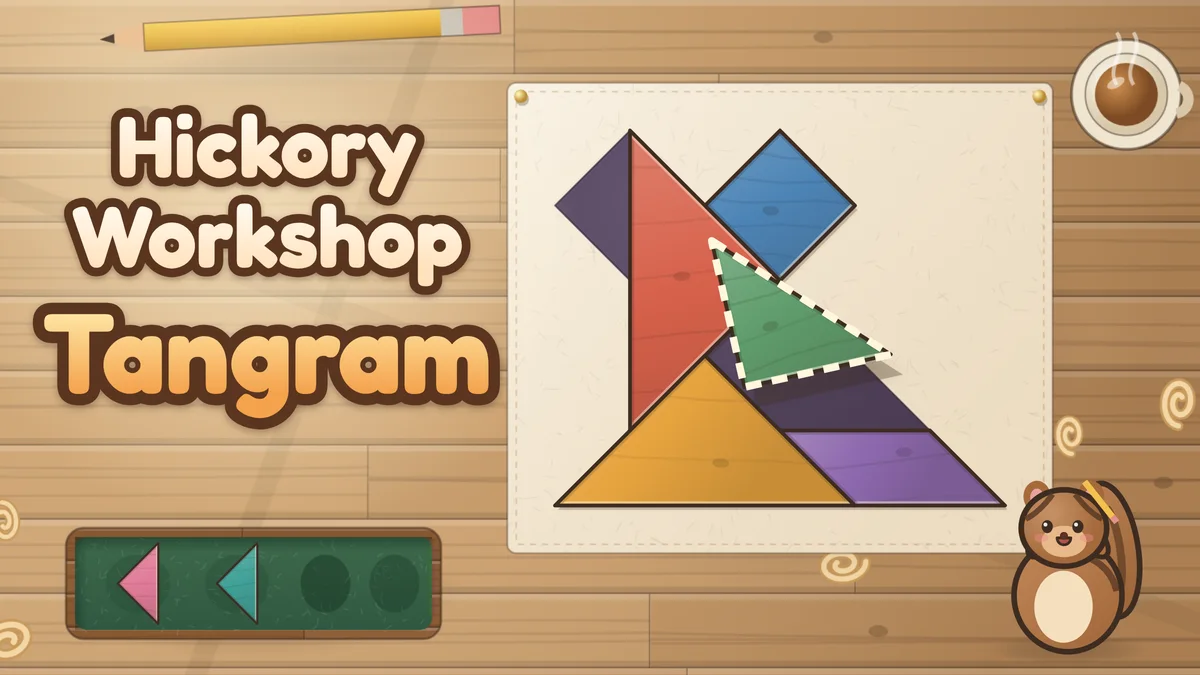
This guide covers the seven pieces and how their sizes fit together, the rules, how to cut your own set from a sheet of paper, a short history of the puzzle from cited sources, and the solving habits that matter most. It also explains the controls in Hickory Workshop Tangram, where you can play tangram online free with 60 original figures and a new shape every day. Every number about strategy comes from our own simulation over the game’s figures, and is labeled as such.
What is a tangram?
A tangram is a dissection puzzle: one shape, a square, cut into pieces that can be put back together into many other shapes. Wikipedia’s article on the tangram describes seven flat pieces, called tans, which are put together to form shapes, and gives the aim as making a given outline using all seven pieces without overlap. Its Chinese name is 七巧板, qīqiǎobǎn, which the article translates as “seven boards of skill.”
A tangram problem is usually printed as a solid silhouette, so the lines between the pieces are hidden. Some outlines are pictures, such as animals, people, boats and houses; others are letters, numbers or plain geometric shapes. The same seven pieces make all of them, which is why one small set can last for years.
The seven pieces
All seven pieces come from one square, and every corner of every piece is 45, 90 or 135 degrees. That is what makes them fit together so well: their sides come in only a few lengths, and the long side of one piece often matches the short sides of another put together.
The easiest way to compare their sizes is in small triangles. Each large triangle is as big as four small triangles. The medium triangle, the square and the parallelogram are each as big as two. The whole set adds up to 16 small triangles, so each large triangle is a quarter of the square, and the two of them together are half of it.
Only one piece changes when you turn it over. The triangles and the square look the same face up or face down, but the parallelogram is the one piece without a mirror line, so flipping it gives its mirror image, a parallelogram that leans the other way. Many figures need it one particular way round.
| Piece | How many | Size in small triangles | Share of the square |
|---|---|---|---|
| Large triangle | 2 | 4 each | One quarter each |
| Medium triangle | 1 | 2 | One eighth |
| Square | 1 | 2 | One eighth |
| Parallelogram | 1 | 2 | One eighth |
| Small triangle | 2 | 1 each | One sixteenth each |
| All seven | 7 | 16 | The whole square |
The rules
The rules fit in one sentence: fill the outline with all seven pieces, without overlapping any of them. In practice that comes to four points.
Use every piece. A figure is not finished until all seven are in it, even when a few of them seem to fill it well enough. Lay the pieces flat and do not overlap them; no piece may sit on top of another. Turn and flip the pieces however you like; any piece may face any way. Fill the outline exactly, so that nothing pokes out past its edge and no gap is left inside.
Many figures can be filled more than one way, and any arrangement that follows the rules counts. Printed puzzle books often give one answer at the back, but if yours is different and still fills the outline with all seven pieces, it is just as right.
Hickory Workshop Tangram checks a finished figure exactly: every piece must sit wholly inside the outline, no two pieces may overlap, and the outline must be covered completely. The moment all three are true, the figure is done.
How to cut your own set from paper
You can make a tangram from any square of paper or thin card. Lay it flat and number the steps as you go; the lines are easy to draw with a ruler.
First, draw a diagonal from the top right corner to the bottom left corner. Mark the middle of that line: it is the center of the square.
Second, mark the middle of the bottom side and the middle of the right side, and join them with a line. That line cuts off the medium triangle in the bottom right corner.
Third, draw the other diagonal from the top left corner, through the center, and stop where it meets the line you just drew. The two triangles above and to the left of the first diagonal are the large triangles.
Fourth, mark the point halfway between the center and the bottom left corner, and draw a line from it to the middle of the bottom side. That makes a small triangle in the corner and a square beside it.
Fifth, mark the point halfway between the center and the top right corner, and draw a line from it straight down to where the second diagonal stopped. That makes the second small triangle and the parallelogram. Cut along every line and you have all seven pieces. Color one side of the paper first and the parallelogram will show you when it has been flipped.
How to play in Hickory Workshop Tangram
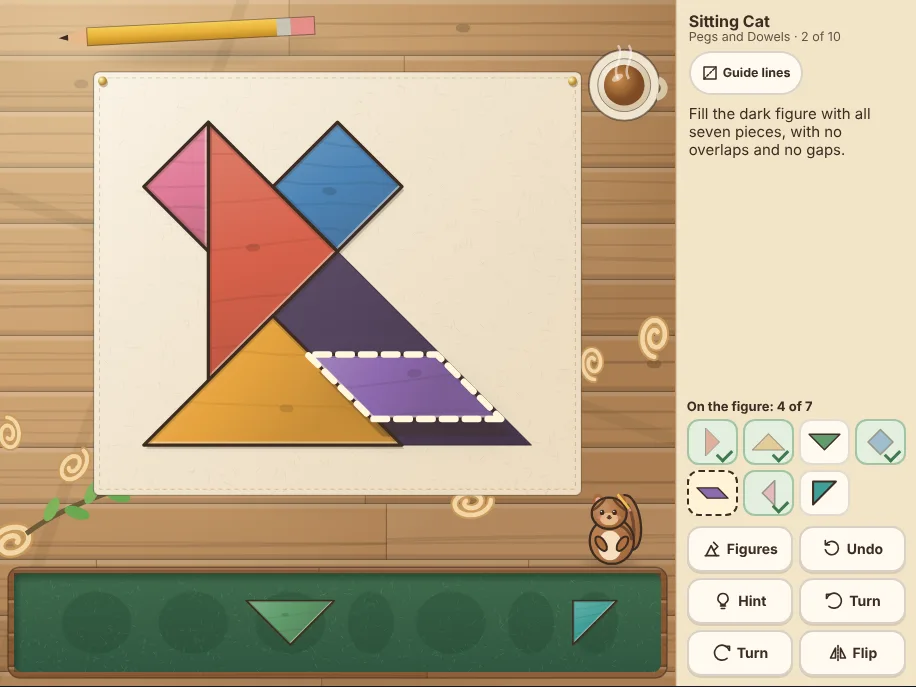
The seven pieces wait in a felt-lined tray beside a pattern card pinned to a woodworker’s bench, and the card shows the figure as a dark silhouette. Drag a piece onto the figure; it snaps into line with the figure and the pieces around it as you let go, so you never have to line up an edge to the pixel. Drop a piece back in the tray to take it off the card.
To turn a piece, tap it once to choose it and again to turn it, or use the Turn buttons. Each turn is 45 degrees, the same step as every corner in the set. The parallelogram has its own Flip button. On a phone, a piece you drag rides just above your finger so you can see where it lands, and you can also tap a piece in the tray and then tap the spot where you want it.
On a keyboard, 1 to 7 choose a piece, the arrow keys move it, Q and E turn it, F flips the parallelogram, Enter sets a piece from the tray on the card and Backspace sends it back. Z and Y undo and redo, H asks for a hint and G shows the guide lines.
Hint places one piece where it belongs. If the pieces you have set are part of a way to finish, the hint keeps them and works around them; if one is in the way, it goes back to the tray and the hint says so. Guide lines sketch one way to fill the whole figure. Both are unlimited, and a figure finished without either earns a star. There is no clock unless you turn one on, though the game quietly keeps your best time for each figure, and everything saves on your device as you go.
The packs and today’s shape
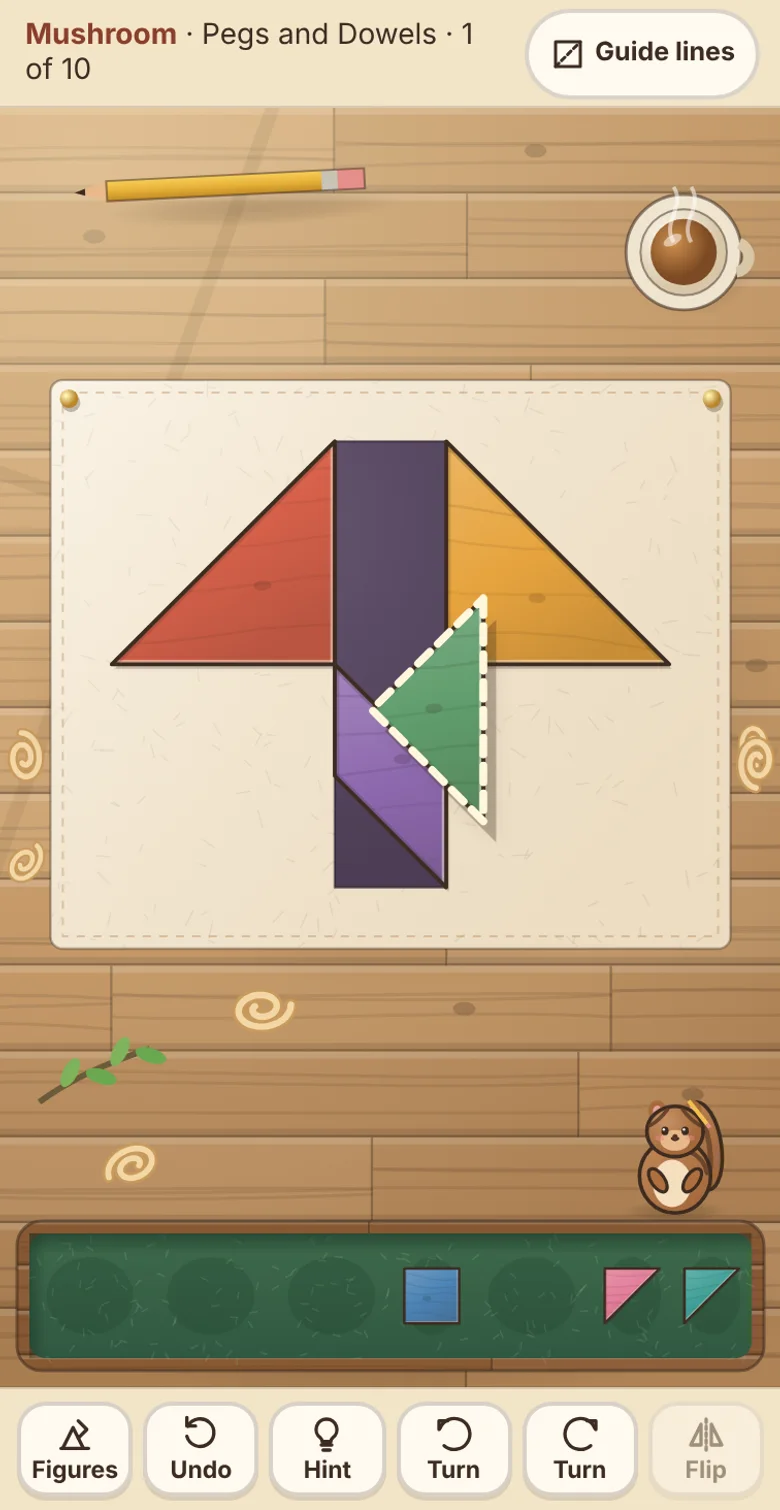
The game’s 60 figures were designed for it from our own piece placements: animals, cottage things, garden shapes and seasonal shapes. They come in six packs of ten, sorted by the game’s own solver, which counts every way to fill each figure and every tempting spot, a place where a piece fits inside the outline but that belongs to no answer at all.
Early figures have many answers and few tempting spots, so almost any sensible start leads somewhere. Later figures have only one or two answers, and most of the places a piece fits are dead ends. The table gives the solver’s count for each pack; two answers that differ only by swapping the two large triangles, or the two small ones, count as one.
Today’s shape is a new figure every day from a bank of 366 plain shapes, the same for everyone on the same date, and it keeps a daily streak. Each daily shape was built from a real arrangement of the seven pieces, so every one can be solved.
| Pack | Answers per figure (fewest, middle, most) | Figures with one answer | Tempting spots |
|---|---|---|---|
| Shavings | 16, 23, 42 | 0 of 10 | 41% |
| Pegs and Dowels | 6, 9, 14 | 0 of 10 | 58% |
| Dovetails | 4, 6.5, 12 | 0 of 10 | 68% |
| Whittling | 2, 4.5, 8 | 0 of 10 | 78% |
| Heirlooms | 2, 2, 4 | 0 of 10 | 85% |
| Masterwork | 1, 1, 2 | 7 of 10 | 89% |
A short history
Wikipedia’s account, which draws on the puzzle historian Jerry Slocum’s The Tangram Book, says the tangram is reputed to have been invented in China around the late 18th century. It was first introduced in a book, Ch’i ch’iao t’u, that was already reported lost by 1815. Chinese sources also credit Huang Bosi, of the Song dynasty, with a set of six “feast tables” that could be arranged in different ways.
The earliest tangram that still exists was given to Francis Waln, a Philadelphia shipping merchant and congressman, in 1802. In 1815 an American captain, M. Donnaldson, was given a pair of books on the puzzle by the author Sang-Hsia-koi, and they reached Philadelphia in February 1816. The puzzle then reached England, where it became very fashionable, and a craze spread across Europe; in Denmark, interest soared around 1818, when two books on it were published.
The word tangram is younger than the puzzle. Its first known use is believed to be in Thomas Hill’s 1848 book Geometrical Puzzle for the Young, and it entered Noah Webster’s American Dictionary in 1864. Where the word comes from is not known for sure. The puzzle maker Sam Loyd later wrote The Eighth Book of Tan, a popular history of the puzzle that was made up; by 1910 it was clear that it was a hoax.
The puzzle has drawn mathematicians too. In 1942, Fu Traing Wang and Chuan-Chih Hsiung proved that the seven pieces can make only thirteen convex shapes, shapes with no dents or notches. According to the same article, over 6,500 different tangram problems have been created from 19th-century texts alone.
How to solve a tangram
Start with the large triangles. Between them they cover half the figure, and they are the least flexible pieces: a large triangle needs a big open area with room for its long side, and in most outlines only a few places offer one. Find where they must go and the rest of the figure often falls into place.
To see how much the order matters, we ran our own simulation: a builder with no foresight that sets the pieces one at a time, each in a random spot where it still fits inside the figure without overlapping anything, and fails when the next piece fits nowhere. It made 2,000 attempts on each of the game’s 60 figures for each order. Laying the large pieces first filled the figure about one time in four. A random order filled it about one time in a hundred. Starting with the small triangles almost never worked, because the little pieces scattered across the outline and broke up the open areas the large triangles needed.
A person looks ahead, so you will do much better than this blind builder, but the lesson carries over: put the big pieces where only big pieces can go, and keep the small ones for the end.
| Order of pieces | All 60 figures | Shavings (easiest pack) | Masterwork (hardest pack) |
|---|---|---|---|
| Large pieces first | 23.8% | 19.6% | 23.6% |
| Random order | 1.0% | 1.5% | 0.4% |
| Small pieces first | 0.0% (rounded) | 0.0% (rounded) | 0.0% (rounded) |
Tips for tricky figures
Read the corners. A sharp 45 degree point in the outline can only be filled by the tip of a triangle or the narrow end of the parallelogram. A square corner takes the square, the right angle of a triangle, or two pieces meeting. Long straight edges usually belong to the long side of a large triangle.
Count the area. If the space left over after a few pieces does not match the pieces still in your hand, something has gone wrong earlier. A gap the size of two small triangles might take the square, the parallelogram, the medium triangle or both small triangles, but the shape of the gap decides which.
Flip the parallelogram. When it will not sit in a gap that is the right size, it is almost always facing the wrong way.
Keep the small triangles flexible. They fit the narrow points and leftover corners that nothing else can, so leave them in the tray until the end.
Use a hint as a nudge. In Hickory Workshop Tangram a hint places a single piece, often a large triangle, and the rest of the figure is still yours to work out. Guide lines are a bigger help, so try a few moves before turning them on.
Related games
If you enjoy fitting shapes together, Little Stitches is our nonogram game, where number clues reveal a picture square by square and each finished pattern joins a quilt. Sprout Sudoku offers classic 9x9 puzzles with hints that explain the next step. Rainy Day Jigsaw has twelve cozy illustrated pictures to put together at your own pace, in 12 to 96 pieces.
Keep puzzling
Tangram comes down to a few habits: find where the two large triangles must go, read the sharp corners of the outline, flip the parallelogram when it will not sit, and keep the small triangles for the gaps at the end. Start with the Tea Tray in the Shavings pack, which teaches the moves one line at a time, and work your way toward the Masterwork figures, where most outlines have exactly one answer. For more calm classic puzzles, try Little Stitches, our nonogram quilting game; Sprout Sudoku, with hints that explain the next step; or Rainy Day Jigsaw, with twelve cozy pictures to put together in 12 to 96 pieces.
- Play Hickory Workshop Tangram
- Hickory Workshop Tangram: features, controls and FAQ
- Little Stitches: cozy nonogram puzzles that stitch a quilt
- Sprout Sudoku: classic 9x9 puzzles with helpful hints
- Rainy Day Jigsaw: twelve cozy pictures, 12 to 96 pieces
- How to play nonograms: rules and solving techniques
- How to play sudoku: rules and solving techniques
- More cozy classic games
More guides and roundups
Match mahjong tiles, solve sudoku and killer sudoku, slide 2048 tiles, stitch a nonogram, find hidden words, fit a jigsaw, rake leaf piles, sort shells, merge fruit or crack firefly codes. Choose a puzzle by the decisions it asks you to make.
Free Online Games for Seniors and Older AdultsFree online games for seniors and older adults: solitaire, mahjong, word search, sudoku, jigsaw and nonograms that open in a browser, with no countdown, no accounts and no purchases. Here is how the eight compare on round length, timers and help.
How to Play Dots and Boxes: Rules and StrategyDots and boxes is the pencil-and-paper game of joining dots and claiming boxes. Here are the rules, board sizes and extra turns, then the strategy that wins: safe lines, chains, leaving the last two boxes and the long chain rule, with how strong each level of our computer opponent is.
How to Play Reversi: Rules, Setup and StrategyReversi is the two-player board game of trapping and turning over discs. Here is how to set up the board, what makes a move legal, how discs flip in all eight directions, when you pass, how the game ends, how strong each level of our computer opponent is, and the strategy, common mistakes and tips that win more games.