Cozy Classic
Free Tangram Puzzles
Hickory Workshop Tangram
A tangram with real wooden pieces you drag, turn in 45 degree steps and flip, 60 original figures in six packs from gentle to plain, today's shape from a bank of 366, hints that place one piece at a time, guide lines, undo and no clock unless you want one.
What you do
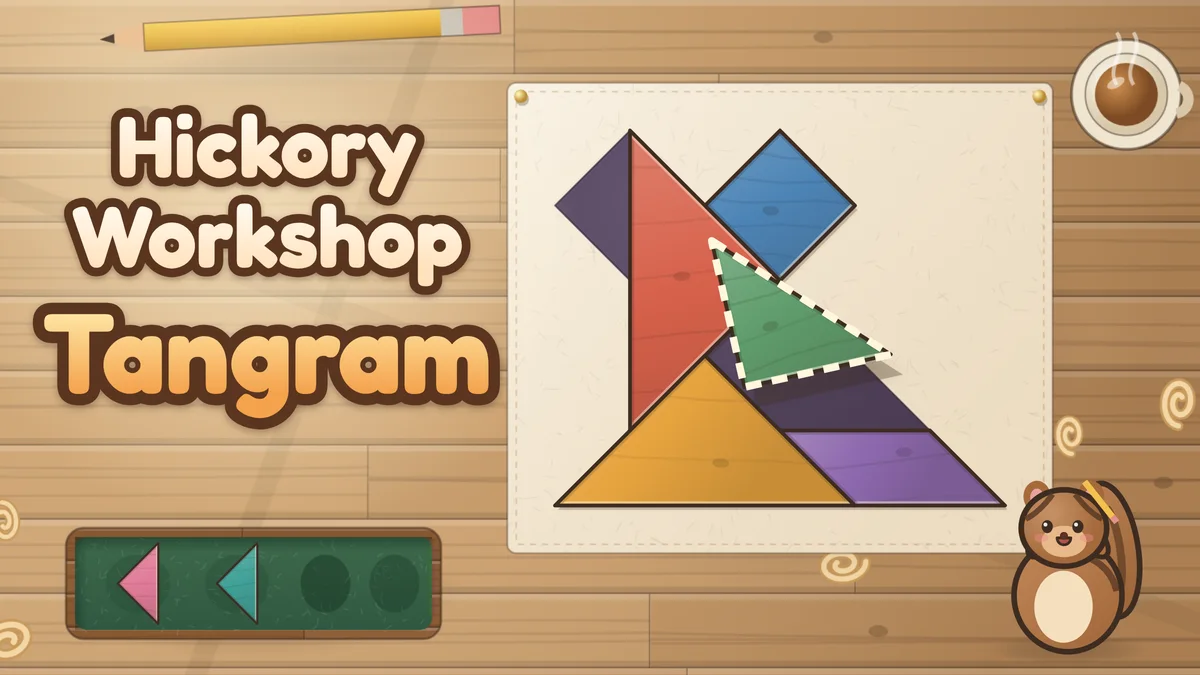
Hickory Workshop Tangram is the traditional seven-piece dissection puzzle, set on a workbench by a sunny window. Seven pieces cut from one square of wood wait in a felt-lined tray: two large triangles, a medium triangle, a square, a parallelogram and two small triangles. Each pattern card pinned to the bench shows a dark silhouette, and your job is to fill it with all seven pieces, with no overlaps and nothing left uncovered. The 60 figures were designed for this game from our own piece placements: animals such as a sitting cat, a goose and a turtle, cottage things such as a teapot, a footstool and a milk carton, garden shapes such as a tulip, a watering can and a garden gnome, and seasonal shapes such as a falling leaf, a bell and a gift box. Your workshop neighbor is Tamsin, a striped chipmunk with a pencil tucked behind one ear, who watches your pieces land, thinks along when you ask for a hint and cheers when a figure is finished.
- 60 original figures in six packs, sorted by the game's own solver from the most forgiving to the plainest: Shavings, Pegs and Dowels, Dovetails, Whittling, Heirlooms and Masterwork.
- Today's shape: a new figure every day from a bank of 366, the same for everyone on the same date, with a daily streak.
- Hints that place one piece at a time, keeping the pieces you have already set when they are part of a way to finish, and guide lines that sketch one way to fill the figure.
- Pieces snap into line with the figure and with each other as you let go, so you never have to line up an edge to the pixel, and the game checks the finished figure exactly.
- Undo and redo for every move, a restart that undo can take back, and no clock unless you turn one on. Best times are kept either way, with a star for figures finished without help.
- Your progress on every figure saves in this browser as you go, so a half-finished figure waits on the bench for you.
How to play
- Press Start the first figure on the title card. The first figure, the Tea Tray, teaches the moves in one short line at a time above the bench.
- Fill the dark figure on the pattern card with all seven pieces. Every piece must be used, pieces may not overlap, and no part of the figure may be left uncovered.
- Drag a piece from the tray onto the figure. Pieces snap into line when they are close, and a piece set wholly on the figure gives a little sparkle.
- Turn a piece by tapping it once to choose it and again to turn it, or with the Turn buttons. Each turn is 45 degrees. The parallelogram is the only piece that looks different face down, so it has its own Flip button.
- When every piece sits inside the figure with no overlaps and no gaps, the figure is finished. Tamsin cheers, the pieces glow and the next figure is one tap away.
- Stuck? Hint places one piece where it belongs, and Guide lines sketch one way to fill the whole figure. Both are unlimited, and a figure finished without either earns a star.
Controls
- Touch: drag a piece from the tray, and it rides just above your finger so you can see where it goes. Or tap a piece in the tray, then tap the bench where you want it. Tap a chosen piece again to turn it right. The Turn, Flip, Undo, Hint and Figures buttons sit in a row under the bench, and Guide lines sits in the top bar.
- Mouse: drag pieces, click a piece to choose it and click it again to turn it. Drop a piece back in the tray to take it off the figure.
- Keyboard: 1 to 7 choose a piece and N steps to the next one, the arrow keys move it (Shift for half a step), Q and E turn it left and right, F flips the parallelogram, Enter sets a piece from the tray on the card, Backspace sends it back, Z undoes, Y redoes, H asks for a hint and G shows or hides the guide lines. Every button is reachable with Tab, and Escape closes the figures list.
- Toolbar: pause, help, restart (sends every piece back to the tray and resets the figure's clock, and Undo brings them back until your next move; records are never touched), optional sound and fullscreen.
Tips worth knowing
- Place the two large triangles first. They cover half the figure between them, and the points and long straight edges of a figure usually show where they must go.
- Look for the corners. A sharp 45 degree point in the outline can only be filled by a triangle tip or the narrow end of the parallelogram, and a square corner by a square, a triangle's right angle or two pieces meeting.
- Save the small triangles for last. They are the most flexible pieces, so they fit the little gaps that are left at the end.
- If the parallelogram will not fit, flip it. It is the only piece whose mirror image is a different shape.
- Use Hint as a nudge rather than a solution: it places a single piece, and the rest is still yours to work out. Guide lines are a bigger help, so try a few moves before turning them on.
Accessibility
- Everything can be played with a keyboard: 1 to 7 choose a piece, the arrow keys move it along the figure's grid, Q and E turn it, F flips the parallelogram, Enter sets a piece from the tray on the card, Backspace returns it, and Z, Y, H and G undo, redo, hint and show the guide lines.
- The bench is described for screen readers: how many pieces sit wholly on the figure, and the chosen piece with its turn and where it sits. Every move, hint and finish is announced.
- Each piece has its own color and its own shape, the chosen piece wears a dashed outline, and the keyboard focus adds a ring, so nothing depends on color alone.
- Nothing is timed unless you turn the clock on, and there are no mistakes to count: a piece in the wrong place simply waits until you move it.
- Reduced motion moves pieces straight to their spots and keeps the sparkles few and nearly still. A speed setting slows or quickens the piece movement, and sound is optional and never needed to play.
Questions
What is a tangram?
A tangram is a dissection puzzle made of seven flat pieces, called tans, cut from a square: two large right triangles, one medium triangle, two small triangles, a square and a parallelogram. The goal is to arrange all seven into a given shape, shown only as an outline or silhouette, without overlapping them. Wikipedia's article on the tangram gives its Chinese name as qīqiǎobǎn, "seven boards of skill", and traces the puzzle to China around the late 18th century, before a craze for it spread to America and Europe in the early 1800s.
Can every figure be solved?
Yes. Every figure, and every daily shape, was built from a real arrangement of the seven pieces, and the game stores that arrangement as its solution. The game's checks rebuild every figure from its stored pieces and confirm that all seven sit inside the outline with no overlaps and no gaps. Many figures have more than one answer, and any arrangement that fills the figure counts.
How are the packs sorted?
By the game's own solver, which counts every way to fill each figure and every spot where a piece fits inside it but belongs to no answer at all, a tempting wrong spot. Figures with many answers and few tempting spots come first. By that count, the Shavings figures can each be filled 16 to 42 ways, while seven of the ten Masterwork figures have exactly one answer, counting the two large triangles as interchangeable and the two small ones too.
How do hints work?
Each hint places one piece in a spot where it belongs. If the pieces you have already set are part of a way to finish, the hint keeps them and works around them. If a piece is in the way, it goes back to the tray to make room, and the hint says so. Guide lines draw one way to fill the whole figure in chalk, again keeping your settled pieces when they fit. Hints and guide lines are unlimited; a figure finished without them earns a star.
Is there a timer?
Not on screen unless you want one. The clock is hidden by default, and you can show it from Settings in the Figures list. Either way, the game quietly keeps your best time for each figure, and the clock pauses while a menu is open or the tab is hidden.
What does the game save?
On this device: every figure in progress (where each piece sits, its clock and whether you used help), the best time and star for every finished figure, today's shape and your daily streak, and your settings. It saves after every move, and there is no account.