
CozyWorld game guide · By CozyWorld
This guide covers our own game, written from the current game rules and browser checks.
How to Play Snake: Rules, Controls and Strategy
Snake is the classic game where every piece of fruit makes you longer and your own tail becomes the thing to avoid. Here are the rules, the controls, and four strategies, from running along the wall to the loop that fills the whole board, with numbers from our own simulation.
How do you play snake? You steer a snake around a walled board. It moves on its own, one square at a time, and you choose where it turns. Every piece of fruit it eats makes it one square longer and scores a point. The round ends when the snake runs into the wall or into its own body, so the longer it grows, the harder it is to keep out of its own way. Fill every square of the board and you have won outright.
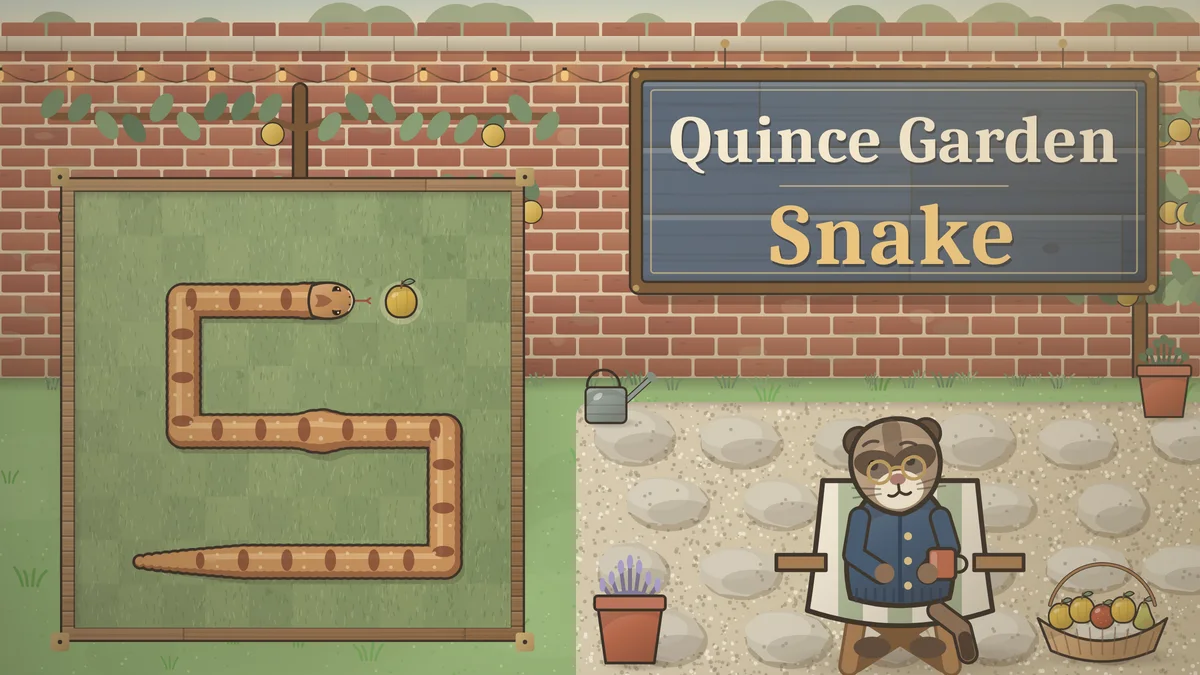
This guide covers the full rules, the controls in Quince Garden Snake, where you can play snake online free on the lawn of a walled kitchen garden, and four strategies: running along the wall, filling space in tidy rows, keeping an escape route, and the loop that fills the whole board. Then come the common mistakes and a few tips. Every strategy number here comes from our own simulation of computer players, run with the game’s own rules, and each one is labeled as such.
What is Snake?
Snake is one of the oldest ideas in video games. It goes back to a two-player arcade game from 1976 in which each player steered a line that grew behind it, and the one who ran into something first lost. One-player versions, where eating makes the snake longer, appeared on home computers from the late 1970s, and in the late 1990s a snake game built into mobile phones brought a new wave of interest in the idea.
The rules have barely changed since. There is a board, a snake that never stops moving, a piece of food, and two things to avoid: the edge of the board and the snake itself. Versions differ in the details: how fast the snake goes, whether the edges are walls or lead round to the other side, and what happens when you crash. The rules below are the classic ones, as Quince Garden Snake plays them.
The rules
The board is a square grid. In Quince Garden Snake it is a lawn of 10, 14 or 20 squares across. A round starts with the snake three squares long on the middle row, facing right, and one piece of fruit on a free square. The snake waits until you give it a direction.
Once it sets off, the snake moves one square at a time in the direction it is facing, and keeps moving. You can turn it up, down, left or right, but never straight back the way it came, because its neck is there.
When the head reaches the fruit, the snake eats it: you score a point, the snake grows one square longer, and a new piece of fruit appears on a free square, never on the snake.
The round ends when the head runs into the wall or into any part of the snake’s body. There is one exception that matters a lot when the snake is long: the square the tail is just leaving is free, so the head can follow the tail around in a tight circle. Your score is the fruit you ate. If the snake ever fills every square of the board, there is nowhere left for fruit, and you have won outright.
| Lawn | Squares | Most fruit in a round |
|---|---|---|
| Small | 10 by 10 (100) | 97 |
| Medium | 14 by 14 (196) | 193 |
| Large | 20 by 20 (400) | 397 |
Modes and speeds in Quince Garden Snake
Classic plays the rules above: the oak edging around the lawn is a wall. Wrap borders the lawn with a gravel path and croquet hoops instead: leave on the right and you come back in on the left, and the same from top to bottom, so only the snake’s own body can end the round. Calm wraps too, runs at 70 percent of the speed you pick, and forgives a bite of your own body: the snake loses three segments from its tail, rests for about a second, and carries on. A Calm round ends only when a bump would leave the snake shorter than three squares, or when you choose Finish round in the menu. The Daily garden is Classic on the medium lawn, with the fruit set by the date, so everyone playing the same day gets the same fruit.
There are three speeds: Gentle moves 5.5 squares a second, Classic 8 and Brisk 11. Outside Calm, the snake gets 1 percent quicker with every fruit, up to 30 percent quicker after 30 fruit. The game keeps a best score for every mode, lawn and speed.
| Mode | The edges | Running into your own body | Speeds up as it eats |
|---|---|---|---|
| Classic | A wall | Ends the round | Yes, up to 30 percent |
| Wrap | Lead round to the far side | Ends the round | Yes, up to 30 percent |
| Calm | Lead round to the far side | Costs three segments and a short rest | No, and 70 percent of the speed |
| Daily | A wall | Ends the round | Yes; medium lawn, Classic speed |
Controls
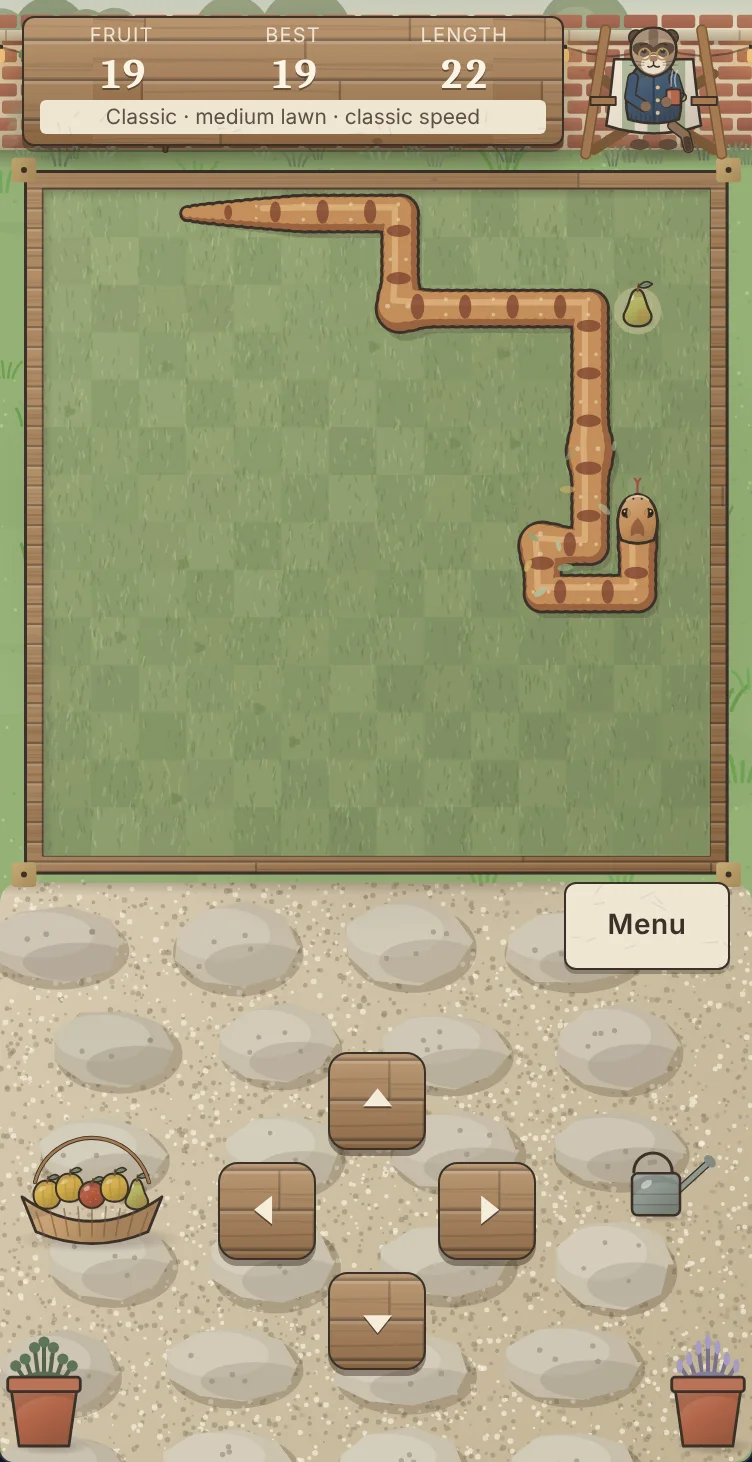
On a keyboard, the arrow keys or W, A, S and D steer, and Escape opens the menu and pauses the round. On a phone or tablet, swipe anywhere in the garden: a turn happens as soon as your finger has moved far enough, and you can keep going in one stroke to make several turns. An arrow pad appears on touch screens, under the lawn on a phone held upright and beside it on a wide screen, and can be turned on or off in Settings. With a mouse, drag the way you want to go.
Turns you make faster than the snake moves are not lost. The game keeps up to three in order, and checks each one against the one before it, so a quick up-then-left while heading right turns the snake up and then left, one square apart, instead of folding it back into its neck. A small brass arrow at the head shows the next turn waiting.
If you switch to another tab or window, the snake stops where it is and waits for your next arrow. The menu has Finish round, which ends the round where it stands and keeps its score, and New round, which starts again without counting the round.
Beginner strategy: the first twenty fruit
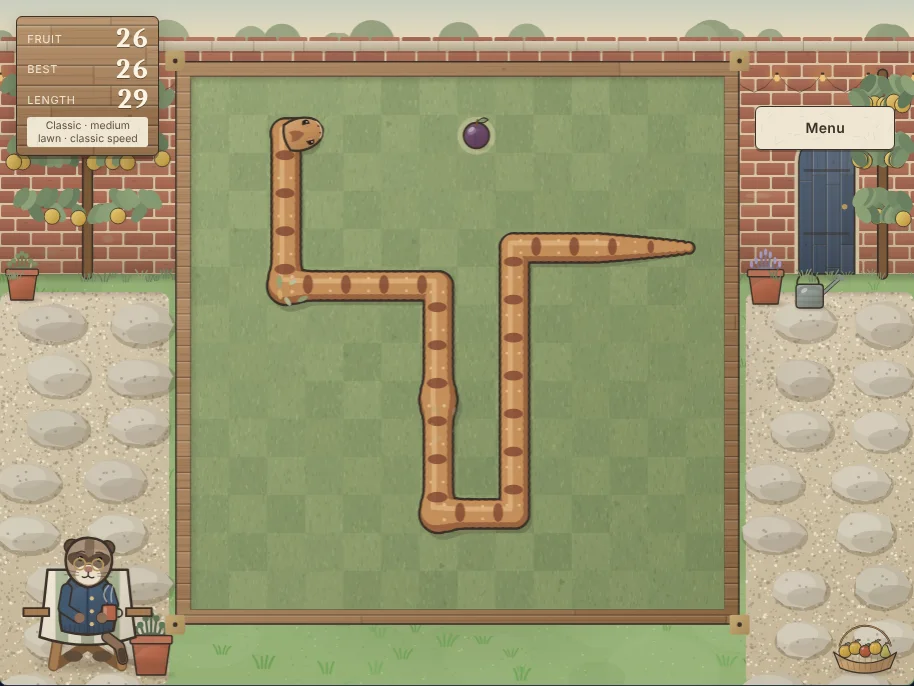
While the snake is short, the board is nearly empty, and the right move is simple: go for the fruit by the shortest way. The snake can only crash into itself if it doubles back around something, and at five or six squares long it has very little to double back around.
Turn early rather than late. The snake turns at the square its head is gliding into, so press while the head is still on its way to the square where you want to turn. Once it has arrived and is moving on, the turn happens one square later. At Brisk, or once the speed has crept up, that window is short, so have the next turn ready before the head gets there.
Plan two turns at a time. Most fruit is an L-shaped trip away: so many squares across, then so many up or down. Decide which leg comes first before you set off, and pick the one that keeps your body out of the way of the second leg.
Wall hugging: run along the edges
In Classic, the wall is the one thing on the board that never moves. A snake that lies along the wall uses space that is no good for turning anyway, and leaves the open middle of the lawn free for the head. So when the snake is long and has nowhere in particular to be, run it along the edge.
The catch is that a head running along the wall can turn only one way. Never let the head reach a corner with its own body lying across the only way out, and when you need to leave the wall for a piece of fruit, turn off it early, while the body behind you still leaves room to come back.
In Wrap and Calm there is no wall to hug, because the edges lead round to the far side. There, the same idea works with your own body: lay it down in long straight runs, and use the open lawn beside them.
Zigzag filling: sweep in tidy rows
The danger in snake is not running out of empty squares. It is the empty squares breaking into pieces, so that the head is in one pocket and the room it needs is in another. The tidiest way to use space is to sweep back and forth in long, even rows, like mowing a lawn: across, turn, back across one row over, turn, and so on.
Rows like that keep the free space in one big piece on one side of the snake, so you always know where the room is. Curls, spirals and diagonal staircases leave odd little gaps between the coils, and every gap is a square the head can never use again until the body moves away.
You do not have to sweep the whole lawn. When the fruit is in the open part, go and get it, and return to your rows once you have it.
Keep an escape route
The most important habit for a long snake is to check, before you go in after a piece of fruit, that you can get out again. A fruit in a pocket between your body and the wall can be a trap: the way in is open now, but by the time you have eaten it, the snake is one square longer and the pocket may have closed behind you.
The safest way out is your own tail. It moves out of the way one square every step, so as long as the head can reach the square the tail is leaving, the snake can always follow it around, and the round goes on. When the fruit looks risky, chase your tail for a few moves instead: the body ahead of you will move off, and the way to the fruit often opens.
This one habit made the biggest difference in our simulation. A computer player that always took the shortest path to the fruit averaged 45.5 fruit a round on the medium lawn in Classic, and never once filled it. The same player, made to check first that it could still reach its tail after eating, and to follow its tail when it could not, averaged 189.8 of the 193 possible, and filled the lawn in 48 of 200 rounds.
The full-board loop
There is a way to play snake that never loses: pick one closed path that passes through every square of the board exactly once, and follow it forever, whatever the fruit does. On a 14 by 14 lawn, one such loop goes back and forth along the rows across thirteen of the columns and comes home up the first column. The snake lies along the loop behind its head, so the head only ever moves onto the square the tail has just left or onto empty lawn, and it never crashes. Every piece of fruit is somewhere on the loop, so the snake reaches it eventually.
The loop is perfectly safe and very slow. The fruit can be almost anywhere, and the snake waits for the loop to bring it there, so the average trip is about half the board. In our simulation the loop filled the lawn in every round, 20 of 20 on each size, and took about 4 minutes on the small lawn, 16 on the medium and 65 on the large at the Classic speed. Most players use the loop only when the snake is long and the board is crowded, and take shortcuts across it while the snake is short.
A loop through every square exists only when the board has an even number of squares. Color the board like a checkerboard: every step goes from a light square to a dark one or back, so a closed loop needs exactly as many light squares as dark ones. A board 15 squares across has 225 squares, one more of one color than the other, and no such loop. That is why the lawns in Quince Garden Snake are 10, 14 and 20 squares across: on every one of them, a full lawn can be reached by patience alone.
| Lawn | Shortest path, average fruit | Escape check, average fruit | Escape check, full lawns | Loop: time to fill at Classic speed |
|---|---|---|---|---|
| Small, 10 by 10 | 30.2 | 94.9 of 97 | 69 of 200 | About 4 minutes |
| Medium, 14 by 14 | 45.5 | 189.8 of 193 | 48 of 200 | About 16 minutes |
| Large, 20 by 20 | 73.5 | 387.9 of 397 | 9 of 60 | About 65 minutes |
How far simple strategies get
To see how much each idea matters, we ran our own simulation of four computer players with the same rules and fruit as Quince Garden Snake, on the same seeds for each player. The wanderer goes straight four times in five when it is safe and otherwise turns at random, and finds fruit only by chance. Shortest path always takes the quickest way to the fruit around its own body. Escape check does the same, but only after playing the path out ahead of time and checking that it could still reach its tail afterward; otherwise it follows its tail. The loop follows one fixed loop through every square. We stopped a round when a player went ten moves per square of lawn without eating.
Going for the fruit is worth a lot: the shortest path ate six times as much as the wanderer. Checking for an escape route is worth far more. When the escape-check player did not fill the lawn, it got within a few fruit of it and then circled behind its own tail, waiting for a safe way to the last pieces that never came. The loop never failed, at the cost of time.
Wrapping edges helped the shortest-path player, which averaged 57.3 fruit on the medium lawn in Wrap against 45.5 in Classic. In Calm, the same player never ended a round on its own before we stopped it at 200 moves per square of lawn: it bumped into itself about once for every three fruit, lost three segments each time, and kept eating. These are computer players that decide every square with no reaction time, not people, so treat the numbers as a guide to how much each idea helps.
| Player | Average fruit | Middle 80 percent of rounds | Filled the lawn |
|---|---|---|---|
| Wanderer | 7.4 | 4 to 11 | Never |
| Shortest path | 45.5 | 30 to 62 | Never |
| Escape check | 189.8 | 188 to 193 | 48 of 200 |
| Loop | 193 | 193 | 20 of 20 |
Common mistakes
Diving into a pocket. A piece of fruit tucked between your body and the wall is the classic trap. Before you go in, look at where your body will be when you come out, not where it is now.
Spiraling inward. Coiling round and round toward the middle feels tidy, but the head ends up in the smallest space on the board with every way out covered by its own body. Sweep in rows instead, and keep the free space on the outside of your turns.
Turning late. At speed, by the time you see the head sitting on the square where you want to turn and press, it is already moving on, and the turn happens one square too late. Press while the head is still gliding into that square.
Pressing too many arrows. The game keeps up to three turns in order, and plays every one of them. A burst of nervous presses can steer the snake somewhere you did not mean to go a moment later. Press each turn once.
Forgetting the far side in Wrap. When the edges lead round, your own body near the opposite edge is right next to you. Before you slip through a croquet hoop, check what is waiting on the other side.
Tips for higher scores
Practice slowly. Gentle moves 5.5 squares a second against Classic’s 8, and Calm takes another 30 percent off and forgives a bite of your own body, so it is the place to practice long-snake play without losing the round.
Learn the endgame on the small lawn. A full small lawn is only 97 fruit away, and the last twenty, when nearly every square is snake, teach you more about space than the first hundred on a large lawn.
Watch the speed. Outside Calm, the snake is 10 percent quicker at 10 fruit and 30 percent quicker from 30 fruit on, so the turns that were easy at the start come sooner. Press earlier as the round goes on.
Use the Daily garden to compare. The fruit appears in the same places for everyone on the same date, as long as their snake is not lying on the spot, so a good Daily score is a fair one to share.
Keep growing
Snake comes down to space. Early on, go for the fruit and turn early. Once the snake is long, every move is about where the free squares will be when you get there: keep them in one piece, keep a way back to your tail, and when in doubt, follow the wall or the loop rather than the fruit. Start a round of Quince Garden Snake on the small lawn at the Gentle speed, try Calm when you want to practice long-snake play without losing the round, and come back to the Daily garden to see how far you get with the same fruit as everyone else. For more quick classics, try Mulberry Lane Bakery, our 2048 game, or Orchard Catch and Paintpot Lane when you want a different kind of steering.
- Play Quince Garden Snake, our free snake game
- Quince Garden Snake: modes, controls and FAQ
- Mulberry Lane Bakery: the classic 2048 puzzle
- Orchard Catch: catch the falling fruit
- Paintpot Lane: a color match rolling ball game
- Bunny Garden Run: a garden endless runner
- How to play 2048: rules and strategy
- The Orchard Catch guide
- Quick free games for a break
More guides and roundups
Want a bright runner with readable obstacles and tablet-friendly movement? Start with Bunny Garden Run, Firefly Hollow or Duckling River Rescue, then try these cozy flow games.
Best Cozy Easter and Spring Games to Play OnlineAn Easter egg hunt in a village, a bunny that runs, carrots to pop, ducklings to rescue and a frog on a pond, all free, then the spring games worth a look.
Best Cozy Puzzle Games to Play in 2026Match mahjong tiles, solve sudoku and killer sudoku, slide 2048 tiles, make 24 from four number cards, sweep a minesweeper board, stitch a nonogram, find hidden words, unscramble a word, fit a jigsaw, rake leaf piles, sort shells, merge fruit or crack firefly codes. Choose a puzzle by the decisions it asks you to make.
How to Play Math Path Puzzles: Rules and StrategyA math path puzzle gives you a starting number and a map of gates that add, subtract, multiply and divide. Choose one route to the end and bring the biggest number you can. Here are the rules, the remainder rule, the controls and the order-of-operations habits that matter most, with numbers from our own simulation.