
CozyWorld game guide · By CozyWorld
This guide covers our own game, written from the current game rules and browser checks.
How to Play Eight-Ball Pool: Rules and Aiming
Eight-ball is the solids-and-stripes pool game: one player takes the solids, the other the stripes, and the first to clear their group and sink the 8 in a called pocket wins. Here are the rules as the World Pool-Billiard Association writes them, how Fallowmere Pool simplifies them, how to aim with the ghost ball, how to control the cue ball with follow, draw and side, when to play safe, and how strong each level of our computer opponent is.
Eight-ball is played on a pool table with fifteen numbered object balls and a white cue ball. One player takes the solids, numbered 1 to 7, and the other the stripes, 9 to 15. You pot your seven, then the 8, in the pocket you name. Pot the 8 too soon, in the wrong pocket, or on a foul, and the frame is lost. It rewards planning as much as potting.
This guide covers the standard rules as the World Pool-Billiard Association (WPA) writes them: the table and the rack, the break, the open table and the groups, what makes a shot legal, fouls and ball in hand, and calling the 8. Then it explains how Fallowmere Pool (CozyWorld’s free pool game, played in the back snug of an old inn against Hester the lynx) simplifies them for a computer table, how to aim with the ghost ball, how to control the cue ball, when to play safe, and how strong each level of the computer opponent is. The strength figures come from our own simulation, which plays the game’s real physics, rules and opponent against each other.
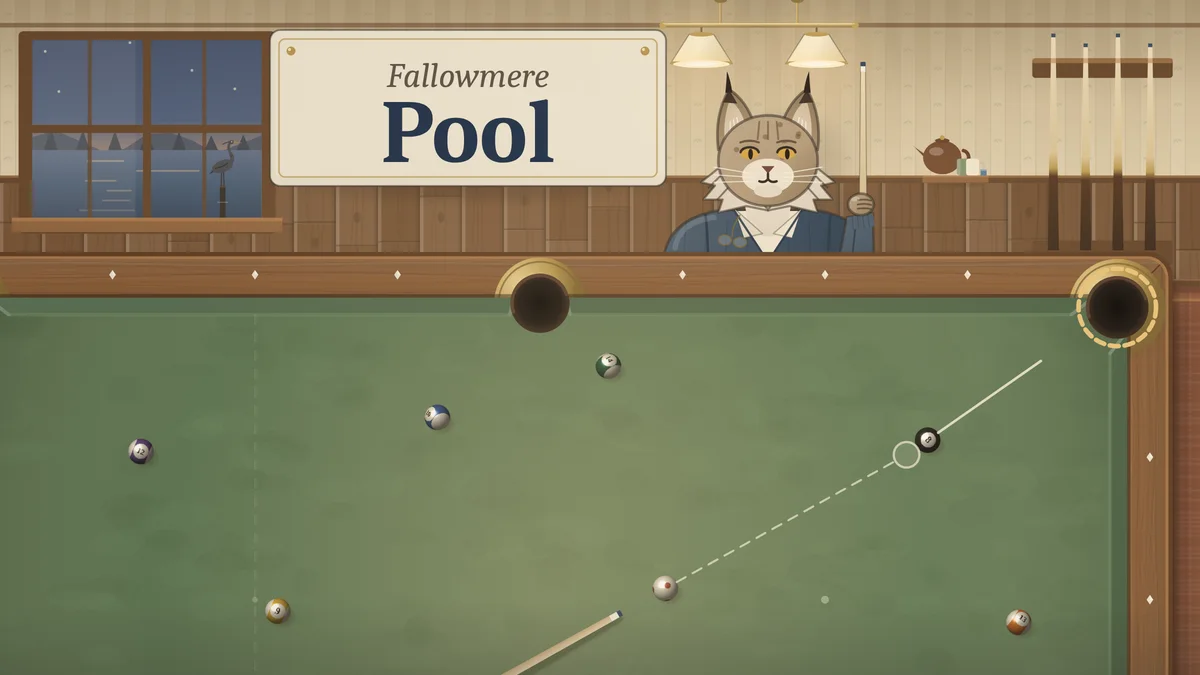
The table, the balls and the rack
A full-size pool table is 9 feet long, and its playing surface, measured between the noses of the cushions, is 100 inches by 50. The balls are 2¼ inches across. There are six pockets: one in each corner and one in the middle of each long side. The side pockets are about half an inch wider than the corner pockets, and a ball has to come in more squarely to drop in one. Pearl sights, often called diamonds, sit on the rails every 12½ inches as aiming marks.
The end you break from is the head of the table. A line across it a quarter of the way up is the head string, and the area behind it is where the cue ball starts. The spot a quarter of the way from the far end, on the line down the middle of the table, is the foot spot.
The fifteen object balls are racked tightly in a triangle with the front ball on the foot spot and the 8 in the middle of the third row, directly behind the front ball. One solid and one stripe go in the two back corners, and the rest are placed at random.
Fallowmere Pool plays on that 9-foot table, with the head of the table at the bottom of the screen on a phone held upright and on the left on a wider screen. Its pockets are a touch more generous than tournament pockets, which on a screen feels about right.
Eight-ball rules: the break
The breaker places the cue ball anywhere behind the head string and shoots into the rack. No ball has to be called on the break, and the cue ball may hit any ball first. Most players strike the front ball full and hard.
A legal break must pot a ball or drive at least four object balls to a cushion. If it does neither, it is an illegal break. If the breaker pots a ball without fouling, they play on, and the table is still open: the break does not decide the groups.
Under WPA rules the incoming player chooses what happens after an illegal break, and the breaker chooses what happens when the 8 drops on the break. Fallowmere Pool keeps it simple. After an illegal break the balls are racked again and the other player breaks. An 8 potted on the break comes back to the foot spot, or as close behind it as the other balls allow, and the breaker plays on. A scratch on the break, potting the cue ball, is a foul like any other.
The open table and choosing groups
After the break the table is open: neither player has a group yet, and you may hit any ball first except the 8. In the WPA rules you call the ball and pocket for each shot, and potting the called ball gives you its group. Fallowmere Pool asks for a call only on the 8: the first ball you pot without a foul after the break gives you its group, solids (1 to 7) or stripes (9 to 15), and your opponent takes the other.
If a solid and a stripe drop on the same shot of an open table, the one that dropped first decides. Pot one of the other group by accident later and it simply stays down, which helps the player whose ball it was.
Taking turns: what makes a shot legal
On every shot after the break, the cue ball must hit one of your own balls first (any ball but the 8 while the table is open). Then a ball must go into a pocket, or any ball, the cue ball included, must touch a cushion after that first contact. A soft tap that leaves everything short of the cushions is a foul.
If you pot one of your balls without fouling, you shoot again. If you pot nothing, or only your opponent’s balls, the turn passes, and your opponent plays the cue ball from where it stopped.
Fouls and ball in hand
A foul ends your turn and gives your opponent ball in hand anywhere: they may pick up the cue ball and put it wherever they like on the table before they shoot. That is a big advantage, so fouls are expensive even though they cost no points.
The WPA list of fouls also covers things a player does at a real table: touching a ball with your hand or clothes, a push shot, a double hit, shooting while the balls still move, no foot on the floor. Fallowmere Pool cannot see any of those, so it judges the four in the table, which are the ones that come up on every table.
| Foul | What it means | What happens |
|---|---|---|
| Scratch | The cue ball goes into a pocket | Ball in hand anywhere for the other player |
| Miss | The cue ball hits nothing at all | Ball in hand anywhere for the other player |
| Wrong ball first | The first ball hit is not one of yours (or is the 8 on an open table) | Ball in hand anywhere for the other player |
| No cushion | Nothing is potted and no ball reaches a cushion after the first contact | Ball in hand anywhere for the other player |
Calling the 8, and how to lose the frame
Once your group is cleared, the 8 is your ball. Before you shoot at it you call the pocket you mean to put it in. Pot it there, without a foul, and you win the frame.
There are four ways to lose a frame on the 8, and they apply to both players: pot the 8 before your group is cleared, pot it in a pocket you did not call, pot it on a foul (a scratch on the same shot is the classic one), or knock it off the table, which cannot happen in Fallowmere Pool. None of these apply on the break.
In Fallowmere Pool the call is made for you as you aim: the pocket the 8 is heading for is ringed in brass and named in the message line. To call a different pocket, for a bank or a combination, tap it, or press C to step through the six. Hester names her pocket before she plays.
How Fallowmere Pool simplifies the rules
A computer table needs a few changes from the rules a referee applies. These are all of them, so you know exactly what the game is judging.
| Situation | WPA rules | Fallowmere Pool |
|---|---|---|
| Calling shots | Call the ball and pocket on every shot, or call safety | Call only the 8; any of your balls in any pocket counts |
| Choosing groups | Potting a called ball after the break | The first ball potted without a foul after the break |
| Illegal break | The incoming player chooses: play on, re-rack and break, or have the breaker break again | Racked again, and the other player breaks |
| 8 potted on a legal break | The breaker chooses: spot the 8 and play on, or break again | The 8 is spotted and the breaker plays on |
| Scratch on the break | Ball in hand behind the head string, or the table as it lies | Ball in hand anywhere, as for any foul |
| Fouls judged | Many, including touched balls, push shots and double hits | Scratch, miss, wrong ball first, and no cushion |
| Stalemate | Declared by the referee; the original breaker breaks again | After 300 shots in one rack; the original breaker breaks again |
How to aim: the ghost ball
Every pot starts with one question: where must the cue ball be at the moment it touches the object ball? Draw a line from the pocket through the center of the object ball and carry it on to the far side. The spot on that line one ball’s width behind the object ball is where the cue ball’s center has to be. Players call the imagined ball sitting there the ghost ball. Aim the cue ball at the ghost ball, not at the object ball, and the object ball goes toward the pocket.
A full hit, straight on, sends the object ball forward and most of the speed with it. The thinner the cut, the less pace the object ball takes and the more the cue ball keeps. A cue ball that arrives sliding, with no spin, glances off at a right angle to the object ball’s path; one that arrives rolling bends forward from that line. That is how you can predict where it goes next, and how a thin cut ends in a scratch.
Fallowmere Pool draws the ghost ball for you: a faint circle where the cue ball will meet the first ball in its path, a short line showing where that ball will go, and a fainter one showing where the cue ball glances off. If the first ball in the path is not one you may hit, the ghost ball turns terracotta and is crossed out. Set the guide to short in Settings when you want to practice judging the line yourself.
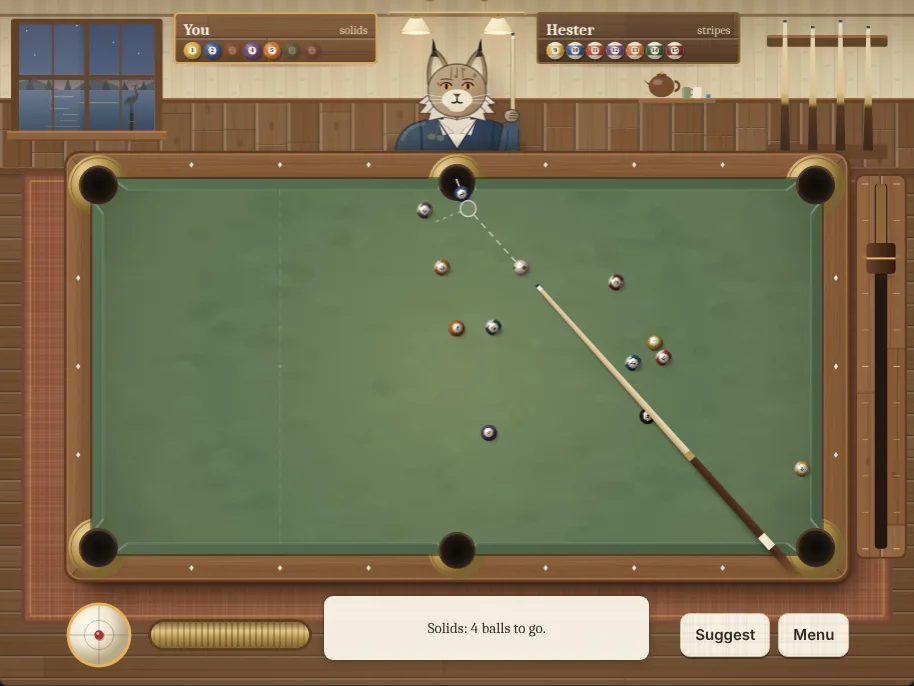
Cue ball control: stun, follow, draw and side
Where the tip meets the cue ball decides what the cue ball does after it hits the object ball. A ball struck in the middle slides at first and then starts to roll forward. If it is still sliding without spin when it meets the object ball straight on, it stops dead: that is a stun shot, the simplest way to keep the cue ball out of the pockets. Struck in the middle from farther away, it has started rolling by the time it arrives and follows on.
Strike above the middle for follow: the cue ball rolls forward after contact. Strike below the middle for draw: the cue ball spins backward, and if the backspin survives the trip to the object ball, the cue ball comes back toward you. Draw fades over distance, so it works best firmer and from closer in; a soft draw shot from far away arrives as a stun or even a rolling ball.
Side spin, struck left or right of the middle, does little on the cloth but changes the angle the cue ball takes off a cushion. Spin toward the direction of travel (running side) makes it come off longer and flatter; spin against it shortens the angle. It is the last thing to learn, because it also makes the aim harder to judge.
In Fallowmere Pool, tap or drag on the cue ball picture beside the table to choose the tip position, or use W and S for follow and draw, A and D for side, and X to go back to the middle. The physics works these out step by step, so the same shot always does the same thing.
Safety play
When there is no pot you would make more often than not, play a safety instead: a legal shot that leaves your opponent nothing easy. The usual ways are to roll one of your balls softly to a cushion and leave the cue ball far away against another cushion, or to leave the cue ball behind a cluster so that none of your opponent’s balls can be seen in a straight line.
A safety still has to be legal: hit one of your own balls first, then make sure a ball reaches a cushion. A safety that fouls hands your opponent ball in hand anywhere, which is the opposite of what you wanted.
Safeties matter most late in a frame. If your opponent has two or three balls left and you have a cluster you cannot open, a good safety that forces them to play a hard shot is often worth more than a long pot that will probably miss and leave them the table.
How to play pool online in Fallowmere Pool
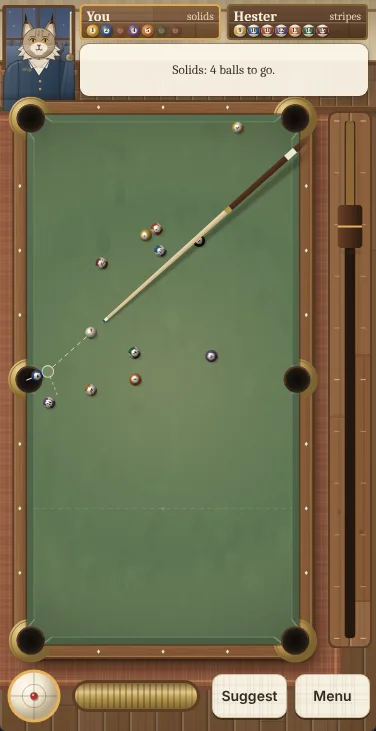
Press Play. Against Hester you break the first frame, and after that the break alternates. Drag on the table to aim: the cue turns to follow your finger or pointer. For small corrections drag the brass wheel under the table, or use the left and right arrow keys (Shift for steps of a tenth of a degree).
To shoot, drag down on the strength slider beside the table and let go: the further you pull, the harder the stroke. A tap on the slider does nothing, so the cue never goes off by accident. With a mouse you can also press on the cue ball and drag back away from the aim, and on a keyboard the up and down arrows set the strength and Space shoots.
With ball in hand, the cue ball has a dashed ring around it: drag it where you want it (or press B and move it with the arrow keys). Suggest sets up a sensible shot for you, which is a good way to learn what the game considers a likely pot. Menu holds Settings, your statistics for each level and the rules, and the frame is saved after every shot, so you can close the page and come back to it.
How strong is Hester?
Hester plays at the level you choose. Gentle finds the easier pots and picks one of them, with a shaky arm, and never plays safe on purpose. Steady takes the two likeliest pots, tries each plain, with follow and with draw through the physics before she plays, keeps the one that leaves her a next shot, and plays safe when none of them goes. Sharp tries every promising pot nine ways, judges what each one leaves, plays safe when nothing is on and kicks off a cushion when she is hooked. Each level then plays its shot with its own wobble in aim and strength, so she misses the way anyone does.
To put numbers on that, we ran our own simulation of 1,000 frames for each pairing, with the break alternating, through the game's own physics, rules and levels. The beginner is a script that knows the rules and the ghost ball and nothing more: it takes the straightest pot it can see, aims with a 2 degree error, judges strength to within about a quarter, always strikes the middle of the cue ball and never plays safe. Alone, clearing a practice rack took the beginner 95.3 shots on average, Gentle 72.4, Steady 29.0 and Sharp 19.8, penalty shots included. These are computer players against each other, not people, so read the table as a guide to how far apart the levels are.
| Who played | Frames won by the first player | Shots a frame |
|---|---|---|
| Gentle against Gentle | 475 of 1,000 (47.5%) | 43.9 |
| Beginner against Gentle | 180 of 1,000 (18.0%) | 46.2 |
| Beginner against Steady | 69 of 1,000 (6.9%) | 28.3 |
| Beginner against Sharp | 31 of 1,000 (3.1%) | 17.3 |
| Steady against Gentle | 892 of 1,000 (89.2%) | 30.0 |
| Sharp against Gentle | 964 of 1,000 (96.4%) | 18.0 |
| Sharp against Steady | 906 of 1,000 (90.6%) | 19.9 |
Common mistakes
Hitting too hard. Most pots need much less pace than it feels like, and a soft stroke keeps the cue ball under control and gives a ball that catches the jaw a chance to drop instead of rattling out.
Aiming at the object ball instead of the ghost ball. Aim the cue ball at the center of the object ball and you hit it full, which sends it straight on, not toward the pocket.
Potting the easy balls first and leaving the hard ones. Clear the balls near clusters and cushions while you still have others to fall back on, and leave yourself a simple last ball before the 8.
Forgetting the cushion rule on a soft safety. If nothing drops, a ball has to reach a cushion after contact, or it is ball in hand for your opponent.
Ignoring the 8. A cut that sends the cue ball into the 8 can knock it in before your group is cleared, which loses the frame on the spot.
Keep playing
Eight-ball rewards a few plain habits: aim at the ghost ball, use the softest stroke that does the job, think one ball ahead, break up clusters while you still have other balls, and play safe instead of hoping. Start against Gentle Hester with the long aim guide, try a practice rack now and then to see how few shots it takes you, and move up to Steady when you win more often than not. For another game of aim and touch, try Garden Putt, mini golf around a sunny garden.
- Play Fallowmere Pool: features, controls and FAQ
- Garden Putt: mini golf around a sunny garden
- Kingfisher Canal Checkers: checkers against Otis the otter
- Lemon Terrace Backgammon: backgammon on a terrace in the lemon groves
- Free online games for adults: calm games worth your evening
More guides and roundups
Checkers, backgammon, reversi, mancala, Chinese checkers and more, free in your browser, then the best places to play chess, Go and the big brand classics online.
How to Play Backgammon: Rules, Setup and StrategyBackgammon is the two-player race game of checkers, dice and the doubling cube. Here is how to set up the board, how the opening roll and moving work, the rule for using both dice, hitting and entering from the bar, bearing off, gammons and backgammons, the cube and the Crawford rule, how strong each level of our computer opponent is, and the basic strategy, common mistakes and tips that win more games.
How to Play Chinese Checkers: Rules and StrategyChinese checkers is the race across a six-pointed star: step or hop your ten marbles into the point opposite before anyone else fills theirs. Here is how to set up for two, three, four or six players, how steps and hop chains work, how a game is won, what to do about marbles left in your home, how strong each level of our computer players is, and the strategy that wins more races.
How to Play Farkle: Rules, Scoring and StrategyFarkle is the six-dice game where you set aside dice that score and decide, throw after throw, whether to bank your points or push on. Here are the rules, the full scoring chart, hot dice and the final round, the common house rules, and strategy with the chances worked out exactly.