
CozyWorld game guide · By CozyWorld
This guide covers our own game, written from the current game rules and browser checks.
Flags of the World: Telling Look-Alike Flags Apart
Chad and Romania, Indonesia and Monaco, Ireland and Côte d’Ivoire, the Netherlands and Luxembourg, Australia and New Zealand: why so many flags of the world look alike, the one detail that tells each pair apart, and how to practice with a free flag quiz.
Many flags of the world look alike because they borrow from the same few sources: the French tricolor, the Dutch horizontal stripes, the Pan-African and Pan-Arab colors, the British blue ensign. A handful of pairs are so close that even a flag enthusiast has to stop and check. Chad and Romania differ only in a shade of blue, Indonesia and Monaco only in shape, and Ireland and Côte d’Ivoire are the same three colors in the opposite order.
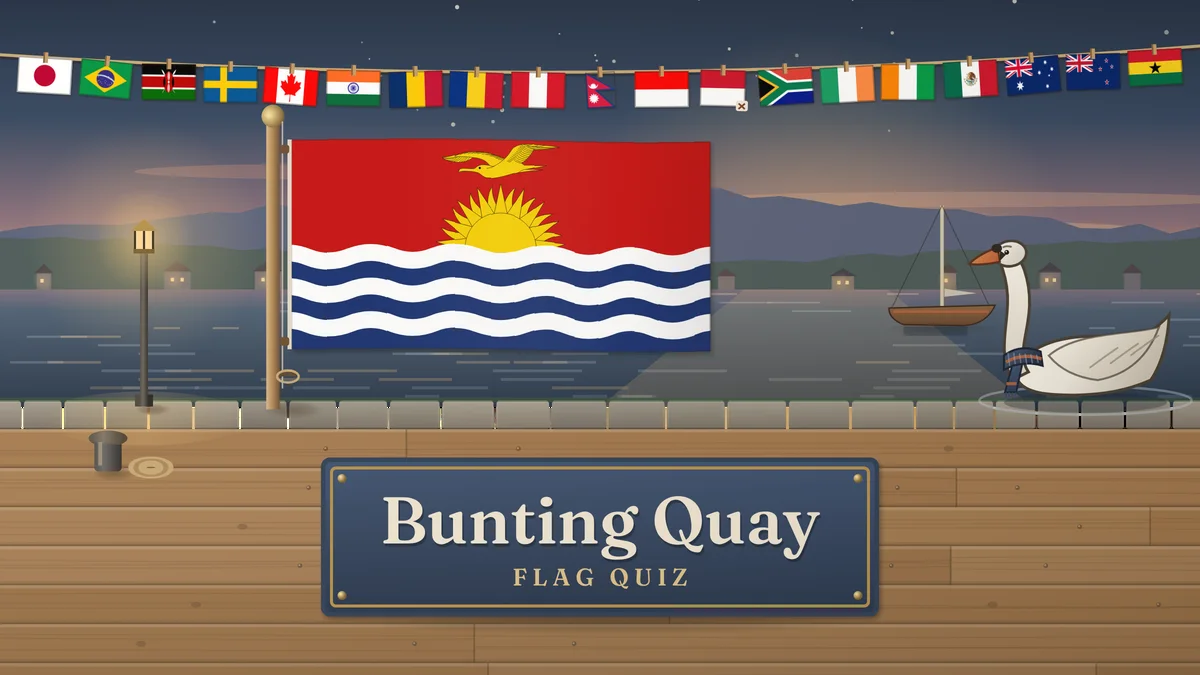
This guide goes through the most often confused flags, with the one detail that settles each pair, then shows how to practice with Bunting Quay Flag Quiz, CozyWorld’s free flag quiz of all 195 countries, played at the end of a harbor quay at dusk. The facts about each flag come from Flags of the World (FOTW), the long-running reference site of flag scholars, and the counts of shapes and look-alikes come from our own count of the game’s flags and our own deal of its questions.
Why so many flags look alike
Most national flags are built from a small kit: two or three stripes, a cross, a canton in the corner, an emblem in the middle, in a handful of strong colors. With 195 countries choosing from the same kit, some near-collisions are bound to happen.
Many are not accidents but family resemblances. Chad’s blue, yellow and red combine the blue, white and red of France with the green, yellow and red of the Pan-African colors, and Andorra’s blue, yellow and red combine the colors of France and Spain, according to FOTW. Countries that share a history or a movement often share colors on purpose, and the look-alikes below show it: green, yellow and red in Mali, Senegal, Guinea and Cameroon, red, white and black in Yemen, Egypt, Iraq and Sudan, white, blue and red in Russia, Slovakia and Slovenia, and the Union Jack in the corner of the flags of Australia and New Zealand.
A few are true coincidences. FOTW’s page on Chad says it plainly: “Accidentally, the flag is the same as the flag of Romania.”
How to look at a flag
Flag makers describe a flag from the hoist, the edge by the pole, to the fly, the free end. A vertical tricolor is named in that order, so Ireland is green, white and orange and Côte d’Ivoire orange, white and green. Most look-alike pairs are settled by asking four questions in turn: which way do the stripes run, what is the order of the colors from the pole or from the top, what shape is the flag, and is there anything extra, a star, a crest, a different shade.
Shape is the question people forget. Flags are not all the same proportions, and Bunting Quay Flag Quiz shows each at its official ones. By our count of the game’s 195 flags, 87 are 2:3 (height to length), 53 are 1:2 and 18 are 3:5, and the other 37 are spread over 22 more shapes. Switzerland and Vatican City are square, Nepal’s two stacked pennants are taller than they are wide, and Qatar, at 11:28, is the longest.
| Proportion (height to length) | Flags | Examples |
|---|---|---|
| 2:3 | 87 | France, Chad, Romania, Indonesia, the Netherlands |
| 1:2 | 53 | Ireland, Australia, New Zealand, Bahrain |
| 3:5 | 18 | Luxembourg, Hungary, Liechtenstein |
| Square, 1:1 | 2 | Switzerland, Vatican City |
| Taller than wide | 1 | Nepal |
| Twenty other shapes | 34 | Belgium 13:15, Monaco 4:5, the United States 10:19, Qatar 11:28 |
Chad and Romania: the shade of blue
Chad and Romania fly blue, yellow and red vertical stripes of equal width, in the same order. They are the closest pair of national flags in the world. The only difference is the blue: the specifications FOTW quotes put Chad’s at Pantone 281, a deeper blue, and Romania’s at Pantone 280, a touch brighter. Side by side the difference shows; alone, almost nobody can tell.
The likeness is younger than either flag. Chad adopted its flag in 1959. Romania had flown the blue, yellow and red tricolor since the nineteenth century, but from 1948 it carried a communist emblem in the middle; in December 1989 the emblem was cut out, at first quite literally, and the plain tricolor was restored.
Two more flags share the colors and settle themselves with a coat of arms on the yellow: Andorra and Moldova. FOTW counts four countries with blue, yellow and red vertical tricolors, these four.
| Country | What to look for |
|---|---|
| Chad | Plain stripes, a slightly darker blue |
| Romania | Plain stripes, a slightly brighter blue |
| Andorra | A coat of arms on the yellow |
| Moldova | An eagle holding a shield on the yellow |
Indonesia and Monaco: the shape
Indonesia and Monaco are both two equal horizontal stripes, red over white. Indonesia’s flag, adopted on 17 August 1945, is 2:3, “two meters by three meters,” as its constitution’s flag article is summarized on FOTW. Monaco’s, adopted on 4 April 1881, is 4:5 in the decree that created it, which makes it noticeably squarer.
In practice the shape is a weaker clue than it sounds: FOTW notes that Monaco’s flag is now almost always made in 2:3, unofficially, so two flags flying side by side may well be identical. In a quiz that draws the official proportions, as Bunting Quay Flag Quiz does, the squarer one is Monaco.
Poland is the third flag in the family, the other way up: white over red.
Ireland and Côte d’Ivoire: which end is green
Ireland and Côte d’Ivoire both fly vertical stripes of green, white and orange, and the trick is to read from the pole. Ireland has green by the pole and orange at the fly; Côte d’Ivoire has orange by the pole and green at the fly. FOTW gives Ireland’s flag as 1:2 and Côte d’Ivoire’s as 2:3, so Ireland’s is also the longer of the two.
Italy is the near neighbor here: green, white and red, from the pole. Further off, Niger and India both run orange, white and green in horizontal stripes; Niger’s has an orange disc in the middle and is nearly square, India’s a navy blue wheel.
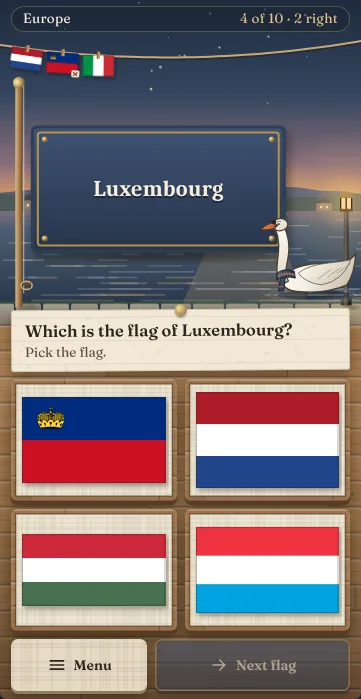
The Netherlands and Luxembourg: how pale the blue is
Both are red, white and blue in horizontal stripes. The Netherlands uses a deep cobalt blue, and its flag is 2:3. Luxembourg’s blue is a light sky blue, and FOTW gives its flag as 3:5 or 1:2, so it is also longer.
FOTW traces Luxembourg’s colors to a circular letter of June 1845 and their use as the national flag to a law of 1972, with the colors specified in 1993. If the blue looks like a summer sky, it is Luxembourg; if it looks like ink, it is the Netherlands.
Australia and New Zealand: the color of the stars
Both are dark blue with the Union Jack in the upper corner by the pole and the Southern Cross in the fly. New Zealand’s Southern Cross is four red five-pointed stars edged in white, and there is nothing under the Union Jack. Australia’s stars are all white: the Southern Cross has four seven-pointed stars and one small five-pointed star, and a large seven-pointed star, the Commonwealth Star, sits under the Union Jack.
So: red stars, New Zealand; white stars and a big star under the Union Jack, Australia. FOTW dates New Zealand’s flag to 12 June 1902 and records the seventh point of Australia’s Commonwealth Star being added in 1908 for the Australian territories.
More look-alike flags at a glance
Bunting Quay Flag Quiz knows 20 groups of look-alikes, covering 50 flags, and after a miss on one of them it shows a tip on telling them apart. These are the rest of the groups, with the detail to check.
| Flags | How to tell |
|---|---|
| Mali, Senegal, Guinea, Cameroon | Mali is plain green, gold and red from the pole; Senegal adds a green star; Guinea runs red, gold and green; Cameroon is green, red and gold with a gold star |
| Russia, Slovakia, Slovenia | Russia is plain white, blue and red; Slovakia adds a shield toward the pole; Slovenia a smaller shield up in the corner |
| Norway, Iceland | Norway is red with a blue cross edged in white; Iceland is blue with a red cross edged in white |
| Colombia, Ecuador, Venezuela | Colombia and Ecuador have a wide yellow band, and Ecuador adds its coat of arms; Venezuela has equal bands and an arc of eight stars |
| Yemen, Egypt, Iraq, Sudan | Yemen is plain red, white and black; Egypt adds a gold eagle, Iraq green script, Sudan a green triangle by the pole |
| Qatar, Bahrain | Qatar is maroon with nine white points and a long flag; Bahrain is brighter red with five points |
| Jordan, Palestine | The same bands and red triangle; Jordan’s triangle holds a small white seven-pointed star |
| Haiti, Liechtenstein | Both blue over red; Haiti has its coat of arms on a white panel, Liechtenstein a gold crown by the pole |
| Belgium, Germany | Belgium’s black, yellow and red stand upright on an almost square flag; Germany’s black, red and gold lie across |
| Austria, Latvia | Austria is bright red with an equal white band; Latvia’s red is darker and its white stripe narrower |
| Thailand, Costa Rica | Thailand has red outside and a wide blue middle; Costa Rica has blue outside and a wide red middle |
| Italy, Mexico | Mexico has its eagle on a cactus in the middle and a longer flag |
| United States, Liberia, Malaysia | 13 stripes and 50 stars; 11 stripes and one white star; 14 stripes and a yellow crescent and star |
| Tunisia, Türkiye | Tunisia’s crescent and star sit inside a white disc; Türkiye’s sit on the red, nearer the pole |
How to practice with Bunting Quay Flag Quiz
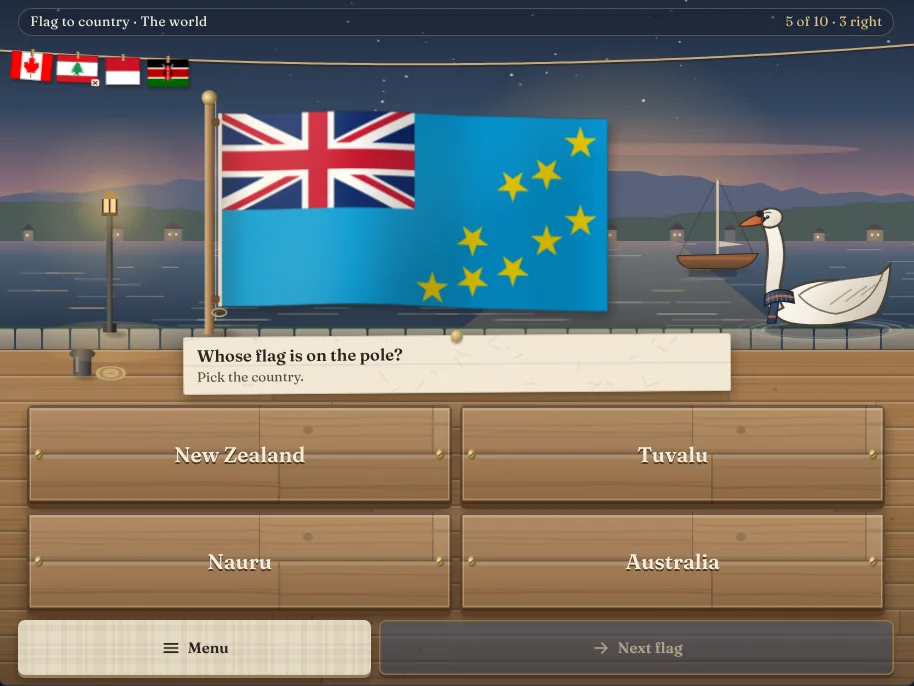
Bunting Quay Flag Quiz has all 193 member states of the United Nations and the two observer states, Vatican City and Palestine. Each question’s flag goes up the quay’s flagpole at its official proportions, and every flag you answer is pegged on the bunting overhead.
There are three ways to play. Flag to country shows a flag and four names. Country to flag shows a name on the quay’s sign and four flags. Type the country asks you to name the flag yourself, and accepts the common other names, such as Ivory Coast, Turkey, Czech Republic and Holland, and a small slip in a longer name, but only when it is nearer that name than any other country’s, so Iran never passes for Iraq. Each way can be played from the whole world or one continent, in rounds of 10, 25 or every flag.
The wrong choices are not random. In our deal of 39,000 Flag to country questions from the whole world, 82.5% of the questions on a flag in one of the look-alike groups offered another flag from the same group as a wrong answer, and 93% of all wrong answers came from the answer’s own continent. That is deliberate: the quiz teaches the pairs by putting them side by side.
Today’s ten is ten flags from the whole world, the same for everyone on the same date, with a result line you can copy that names no flags. It walks through all 195 flags before any comes back; in our check of its first 400 days, every flag had appeared by day 20. Learn mode lets you browse every flag with its capital and continent, by continent or A to Z, with its look-alikes one tap away.
| Continent | Flags |
|---|---|
| Africa | 54 |
| Asia | 48 |
| Europe | 44 |
| North America (with Central America and the Caribbean) | 23 |
| Oceania | 14 |
| South America | 12 |
Common mistakes
Reading a vertical tricolor from the wrong end. Always start at the pole. Ireland and Côte d’Ivoire, and Guinea and Mali, are mirror images of each other.
Ignoring the shape. Monaco, Belgium, Switzerland and Nepal give themselves away by shape alone, and among the red, white and blue tricolors the longer flag is Luxembourg.
Calling every blue the same. The Netherlands’ blue is dark and Luxembourg’s light, and Chad’s is a shade deeper than Romania’s. When two flags match in everything else, the shade is the answer.
Stopping at the colors. When two flags share colors, look for what is added: a star, a shield, a disc, a triangle, a crown. That small extra is usually the whole answer.
Mixing up which way up. Indonesia is red over white and Poland white over red; Thailand has red outside and Costa Rica blue.
Tips for learning the flags of the world
Learn the look-alikes as pairs. Knowing Chad well does not help if you do not know what makes it different from Romania.
Go one continent at a time. A round of Oceania’s 14 or South America’s 12 flags is short enough to finish with every flag, and the wrong choices come from the same continent.
Switch ways of playing. Picking a flag for a name, in Country to flag, is harder than picking a name for a flag, and Type the country is harder still. Each one fixes the flags a little more firmly.
Use the misses. After a round, the quiz lists the flags to look at again, and each one opens in Learn mode with its look-alikes beside it.
Sources
Flags of the World (crwflags.com/fotw), the pages for each flag named here, read on October 31, 2026: Chad (adoption in 1959, the likeness to Romania and the Pantone 281 blue), Romania (the restored tricolor of 1989 and the Pantone 280 blue), Indonesia (adopted 17 August 1945, 2:3), Monaco (adopted 4 April 1881, 4:5, often made 2:3), Ireland (1:2), Côte d’Ivoire (2:3), the Netherlands and Luxembourg (Luxembourg’s 1845 circular letter, 1972 law, 1993 colors and 3:5 or 1:2), Australia (the seventh point of the Commonwealth Star, 1908) and New Zealand (adopted 12 June 1902), and the other flags in the table.
The United Nations, Member States and Non-member States pages (un.org), for the list of 195 countries; the UN Statistics Division’s M49 standard (unstats.un.org), for the continents; and Wikipedia’s List of national capitals, for the capitals in Learn mode.
The flag images in Bunting Quay Flag Quiz are public domain files from Wikimedia Commons, with Oman’s drawn for the game using the MIT-licensed flag-icons emblem. The counts of shapes, look-alikes and continents are our own count of the game’s flags, and the deal and daily figures come from our simulation, scripts/bunting-quay-flag-quiz-sim.mjs, which runs the game’s own rules.
Keep playing
Look-alike flags stop being a problem once you know which detail to look at: the shade of blue for Chad and Romania, the shape for Indonesia and Monaco, which end the green is on for Ireland and Côte d’Ivoire, how pale the blue is for Luxembourg, and the color of the stars for New Zealand. Learn them as pairs, check the shape, read from the pole outward, and practice a continent at a time. For more calm puzzles, try The Curious Case Of..., a daily village mystery; Cottage Word Search, with a hidden saying in every puzzle; or Magpie Green Spot the Difference, which trains the same careful eye.
- Play Bunting Quay Flag Quiz: modes, controls and FAQ
- The Curious Case Of...: a daily village mystery
- Cottage Word Search: themed word searches with a hidden saying
- Magpie Green Spot the Difference: compare two cozy scenes
- How to play spot the difference: where to look first
- Free online games for adults, no download
- Games like Wordle: daily puzzles to try
More guides and roundups
Match mahjong tiles, solve sudoku and killer sudoku, slide 2048 tiles, make 24 from four number cards, sweep a minesweeper board, stitch a nonogram, find hidden words, unscramble a word, fit a jigsaw, rake leaf piles, sort shells, merge fruit or crack firefly codes. Choose a puzzle by the decisions it asks you to make.
How to Play Color by Number: Rules and TipsColor by number turns a picture into numbered squares and asks you to color each one with the paint that has its number. Here are the rules, how pixel color by number works, why dragging beats tapping by our own count, how to zoom and find the last squares, the common mistakes and the tips that make a picture come together.
Best Cozy Detective Games and MysteriesMysteries where the fun is in the thinking. Start with a free village whodunit in your browser, then pick a detective game for a longer case.
Relaxing Games: 15 Calming Games to Unwind WithCalming games for the end of a long day: seven free browser games from CozyWorld with no countdown and no way to lose, then eight relaxing games to download, from Townscaper to A Short Hike.