Cozy Strategy
Hedgerow Hamlet
A cozy card-stacking village game: drop one card on another and a stack that matches a recipe gets to work, from picking berries to baking a berry pie for the Harvest Feast.
What you do
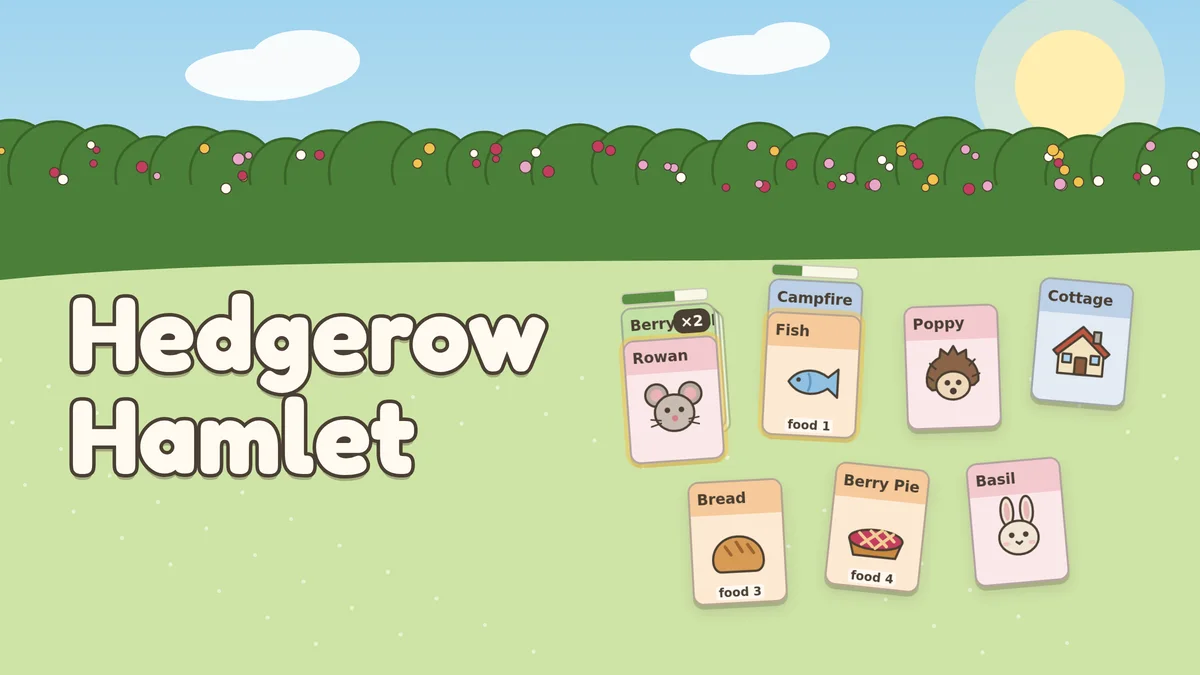
A cozy card-stacking village game played on one table. Every card is something in your hamlet: mouse, rabbit and hedgehog villagers, berry bushes, oak trees, rocks, ponds, sheep, materials, food and buildings. Drop a card on another to stack them, and a stack that matches a recipe starts working: a villager on a berry bush picks berries, a villager on two wood saws a plank, a villager with two wood and a stone builds a campfire, and the campfire grills the fish you put on it. Sell spare cards at the market stall for acorns and open packs of new cards. Each day lasts 90 seconds at normal speed, and at supper every villager eats two food. Nobody fights and nobody is lost for good: a villager who goes hungry two nights in a row goes to stay with family until spring. Build a garden plot, a cottage for a new neighbor, a mill and an oven, sew bunting, set up the Festival Green and serve a berry pie, bread and grilled fish to hold the Harvest Feast in as few days as you can. There are 32 kinds of card and 26 recipes, and a quest line always names a next step. New hamlet deals a fresh table; Today’s hamlet deals the same one for everyone that day. Your hamlet in progress, your notebook of recipes and your records save on this device.
How to play
- Press New hamlet on the title card, or Today’s hamlet for the table everyone gets that day. Continue brings back a hamlet you left.
- Drag a card onto another card to stack them. A stack that matches a recipe starts working and shows a progress bar: a villager on a berry bush picks berries, a villager on an oak tree chops wood, a villager on two wood saws a plank. While you drag, a label over a stack names the recipe your drop would start.
- Villagers do the work, and buildings work on their own: a campfire grills fish and bakes apples, a garden plot grows two carrots or two wheat from one, a mill grinds wheat into flour and an oven bakes bread, or a berry pie from flour and berries. Bushes, trees, rocks and meadows run out after a few uses (the dots on the card); ponds and sheep never do.
- Drag spare cards onto the market stall to sell them for acorns, and tap a pack to buy it: the Forager’s Basket for 3 acorns, the Farmer’s Crate for 5 (it opens after your first campfire) and the Builder’s Bundle for 6 (after your first cottage).
- Each day lasts 90 seconds at normal speed. At supper every villager eats two food, plainest food first, and the top bar shows the pantry against what supper needs. A villager who goes without goes to bed hungry, and eats first the next night; a second hungry night in a row and they go to stay with family until spring.
- To finish, hold the Harvest Feast: build the Festival Green (a villager, three planks and two bunting) and set a berry pie, bread and grilled fish on it. Your record is the fewest days. The quest line under the top bar always names a next step, and tapping any card shows every recipe it is part of.
Controls
- Touch and mouse: drag a card to move it together with every card on top of it. On a pile, drag the card to take one, or drag the count badge to take the whole pile. Tap a card to see what it is for, with buttons to sell it or take it off its stack. Tidy lays the table out in rows.
- Keyboard: Tab to the table, then the arrow keys choose a stack. Enter picks up its top card and Enter on another stack drops it there (Enter on the same stack sets it down on its own). S sells, I describes, T tidies, P pauses time and Escape puts a carried card back. The shop buttons work with Tab and Enter, and with a card carried, Enter on the market stall sells it.
- Top bar: switch between normal and double speed, pause time (you can still move, sell and buy while it is paused) and open the notebook of recipes.
- Toolbar: pause, help, restart (opens the title card: your hamlet stays until you choose to start a new one), optional sound and fullscreen.
Tips worth knowing
- Two villagers need four food every supper and a berry bush gives three berries, so plan the first supper before you build.
- A campfire doubles food: a grilled fish or a baked apple counts as two at supper, and an oven’s bread counts as three.
- Garden plots never run out. Plant a carrot or a wheat to get two back, and replant one of them.
- Ponds and sheep never run out either, so a villager left at a pond keeps fishing until you move them.
- Two villagers in a cottage welcome a new neighbor: one more pair of hands, and one more mouth at supper.
- Pause time whenever you want to plan. Dragging, selling and buying all still work.
Accessibility
- Everything can be played with a keyboard: the arrow keys choose a stack, Enter picks up and drops a card, and every button is reachable with Tab.
- Time can be paused at any time from the top bar, and the game stops time while a card’s details or a supper report are open. Double speed is optional.
- Every card shows its name in text, and food cards show their supper value in words, so nothing relies on color alone.
- Recipes started, sales, purchases, supper reports and quests are announced to screen readers, and the stack chosen with the keyboard is described.
- Reduced motion stops cards sliding and flying across the table. Sound is optional and never needed to play.
Questions
Can a hamlet go wrong?
Gently. Nobody fights and nobody is lost for good. A villager who goes hungry two nights in a row goes to stay with family until spring, and if everyone has gone, the hamlet rests and you start a new one; your notebook and records stay. If you ever run out of things to gather and have too few acorns for a basket, a neighbor leaves a free Forager’s Basket on your doorstep the next morning.
Is Hedgerow Hamlet like Stacklands?
Yes, it uses the card-stacking loop Stacklands made popular: stack cards to gather, craft and build, and feed everyone at the end of each day. Hedgerow Hamlet is CozyWorld’s own cozy take, with no fighting, a Harvest Feast to aim for, a quest line and a table sized for phones. It is not made by or affiliated with Sokpop, the makers of Stacklands.
How long does a hamlet take?
A test bot that plans every move and acts every second holds the feast between day 4 and day 7, most often on day 5, in 200 of 200 test hamlets; at normal speed a day is 90 seconds. People take longer, especially the first time while the recipes are new; we have not measured a typical player’s hamlet. Double speed and pausing are always there, and your hamlet saves as you go.
What does Hedgerow Hamlet save?
On this device: the hamlet in progress, with every card, where it lies and any work under way, your speed setting, the notebook of every recipe you have made, your fewest days to the feast, how many feasts you have held and your best day for each day’s hamlet. Restart in the toolbar opens the title card and never deletes anything; starting a new hamlet asks first. If the browser blocks saving you can still play, and the game says your hamlet lasts only until you leave the page.