
1. Large snow crystal
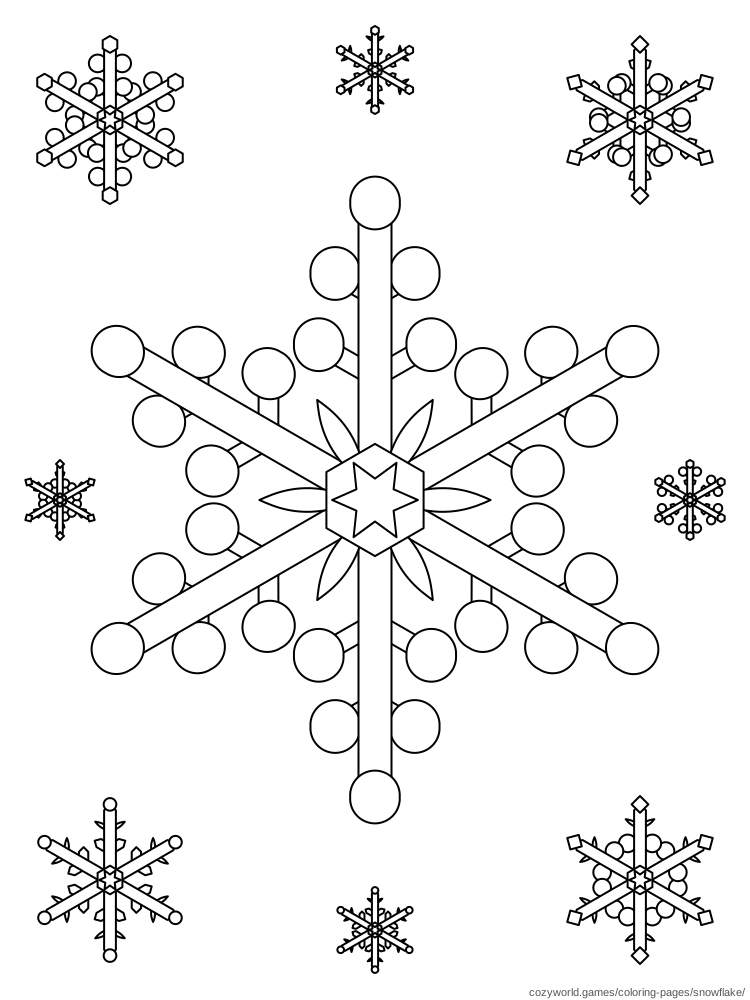
One crystal fills the page, with eight small flakes around it. Each arm has side branches and a tip.
Free printable · Color online
Six pages of snowflakes: two large single crystals with smaller ones in the corners, two pages of flakes in a flurry, and two mandalas with a snow crystal at the center. Every flake has six matching arms, as real ones do.
When you color one on screen with “Color matching shapes together” switched on, a tap on one arm colors all six. Printed, they work well with only two or three blues and a gray.
Each page prints on one sheet of US letter paper. Under every page are buttons to print just that one, to color it on screen, or to save it as a picture.
One crystal fills the page, with eight small flakes around it. Each arm has side branches and a tip.
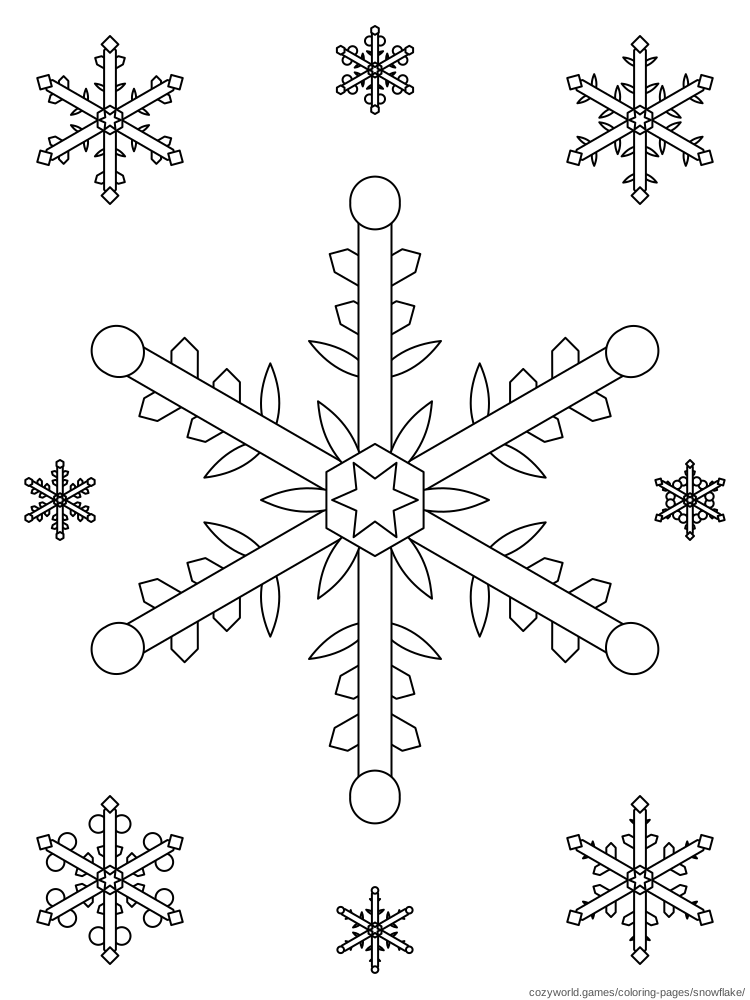
A second large crystal with a different pattern of branches.
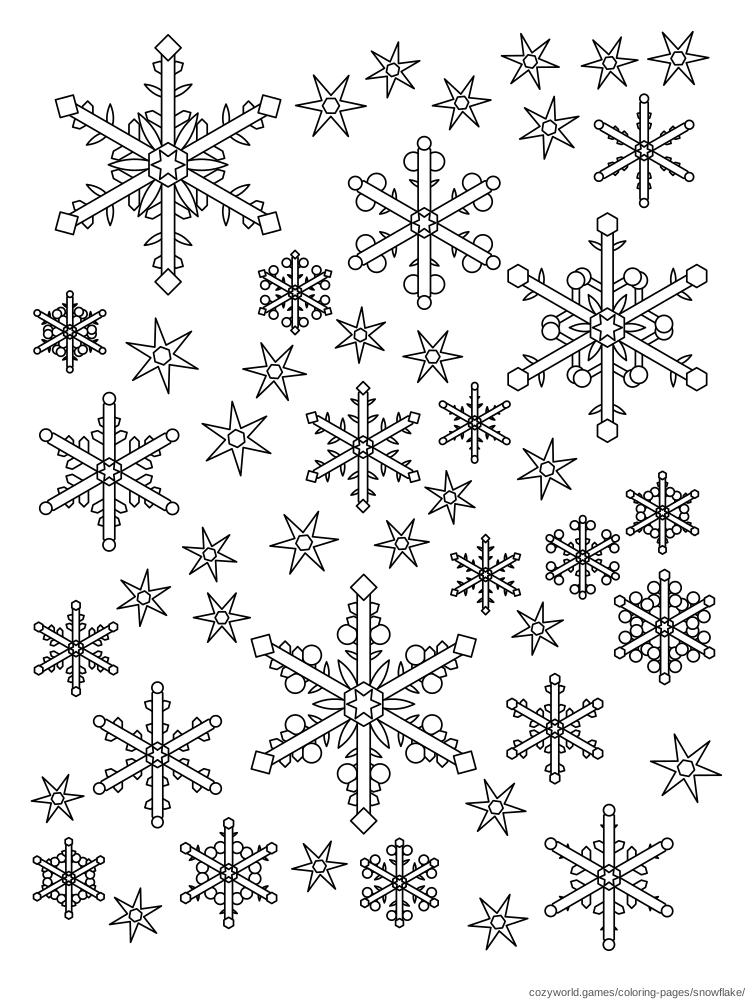
Dozens of flakes in many sizes, the larger ones each with their own pattern of branches.
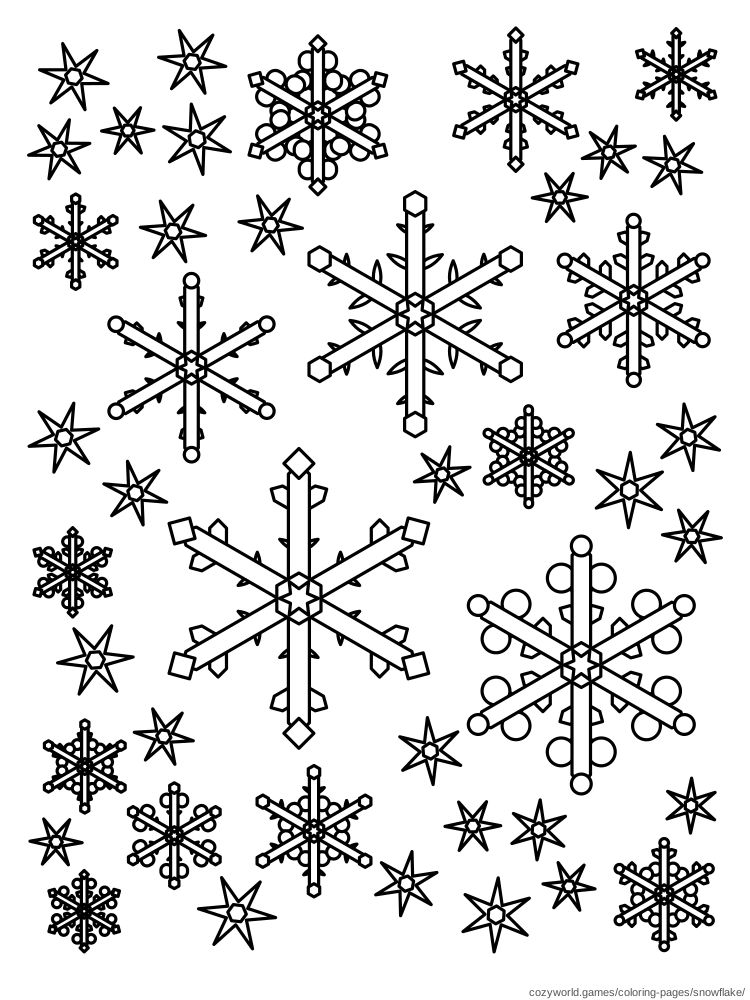
Fewer, bigger flakes with thicker arms and heavy outlines.
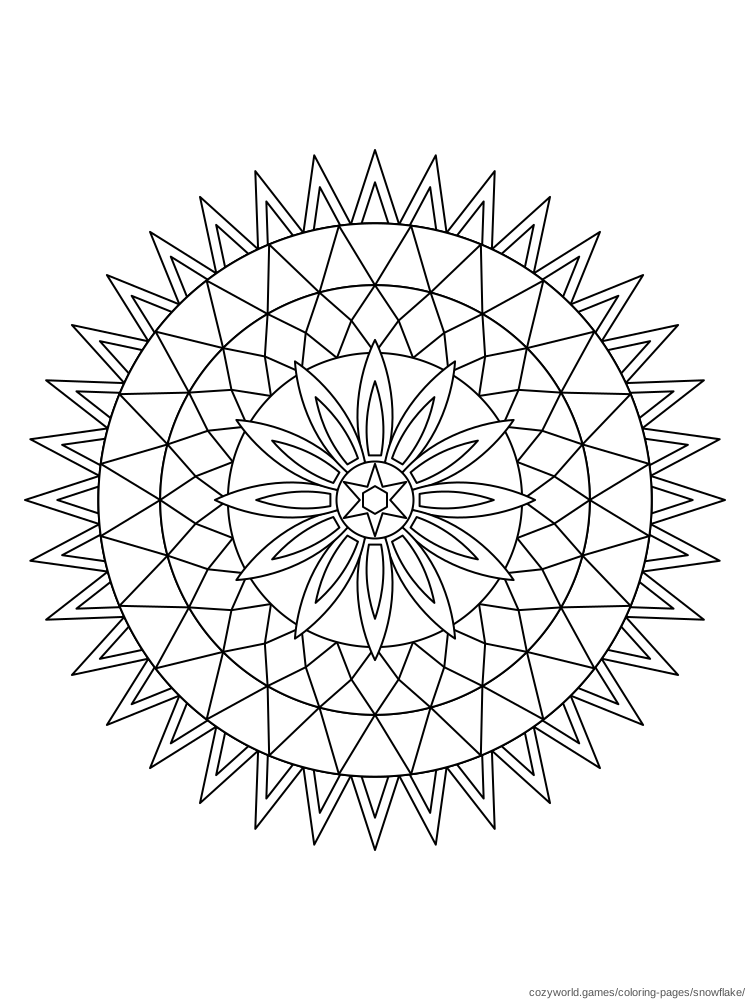
Six-fold rings round a six-pointed crystal, with a sunburst of points at the rim.
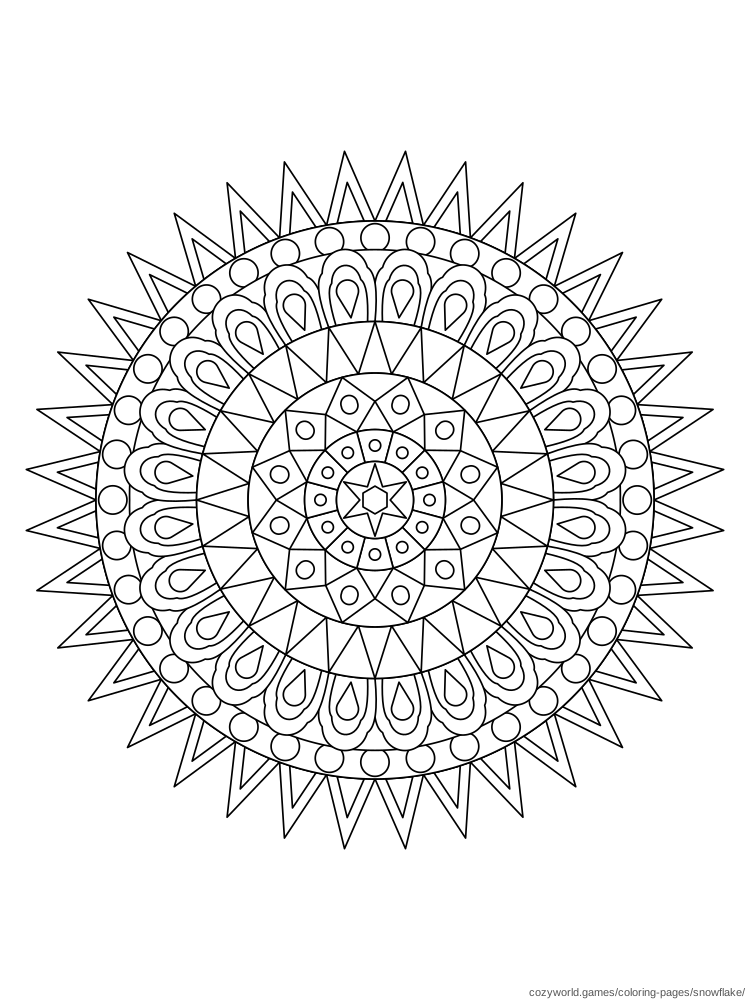
More rings and smaller shapes: one for sharp pencils.
A snow crystal starts as a tiny hexagonal plate of ice, because water molecules lock together in a six-sided lattice when they freeze. As it falls, arms grow from the six corners, and since all six pass through the same air at the same time, they grow in nearly the same way.
The astronomer Johannes Kepler wondered about this in a short essay of 1611, “On the Six-Cornered Snowflake.” In 1885 Wilson Bentley, a farmer in Jericho, Vermont, took the first known photograph of a single snow crystal through a microscope, and he went on to photograph more than five thousand. In 1936 the Japanese physicist Ukichiro Nakaya grew the first artificial snow crystals in a laboratory and showed that their shape depends on the temperature and moisture of the air they form in.
More on how snow crystals form, from the Caltech physicist Kenneth Libbrecht’s SnowCrystals.com.
Snow is white, so color the sky instead: fill the page background with a deep blue and leave the flakes as bare paper, or color only alternate parts of each arm in pale blue and gray.
For a less wintry page, treat the big crystals as jewels: one warm color for the main arms, a second for the side branches and a third for the tips and the center hexagon.
This set has 6 pages: 1 bold and easy, 3 medium and 2 detailed. The quickest to finish is “Snowflake mandala,” with 152 areas to color, and the longest is “A flurry of snowflakes,” with 1048. Bold and easy pages have heavy lines and large shapes that suit markers and tired eyes; detailed pages have fine lines for sharp pencils or gel pens.
How printing, saving and coloring on screen work is explained on the coloring pages home. If you like filling shapes by number, Linseed Loft Color by Number is a free paint by number game with 74 pictures.